Tag Archives: Novel

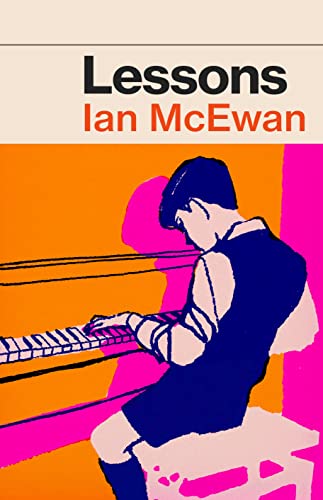
Ian McEwan’s Lessons: page 75

Ian McEwan, Lessons (Jonathan Cape 2022)

This is a tentative experiment in a different way (for me) of blogging about books: take page 75 and write whatever comes to mind about it. After my next birthday, if I keep this up, I’ll take page 76.
Page 75 of Lessons would probably have a red line drawn through it by someone writing a film script. It’s mainly a minor character’s backstory.

By this stage of the novel, the main character, Roland Baines, has been abandoned by his wife, Alissa, with no warning and no real word of explanation, leaving him to care for their infant son. He has received a couple of postcards from European addresses, the most recent saying she is about to visit her parents in Germany. Page 75 begins with his wondering why she is visiting her parents and imagining that if she tells them what she has done, ‘the row would be like no other’. McEwan delivers on this tease later when Roland hears the mother’s account of that row, which is quite different from what he imagines. Later still, that account is confirmed by Alissa herself.

The rest of the page begins the back story of Alissa’s mother, Jane: born in 1920, educated in a grammar school, and by the end of the page nursing literary ambitions working as a part-time typist at Cyril Connolly’s prestigious literary magazine Horizon (a real magazine):

She later told her son-in-law that she was seated in an invisible corner and given the dullest correspondence. She wasn’t beautiful or well connected and socially adroit like many of the young women who passed through the office. Reasonably enough, Connolly barely noticed her but occasionally she was in the presence of literary gods. She saw, or thought she saw, George Orwell, Aldous Huxley and a woman who may well have been Virginia Woolf. But, as Roland knew, Woolf had been dead for two years and Huxley was living in California.

There are many passages like this in the book: passages that fill us in on someone’s background, or summarise a novel or (in one case) a children’s picture book. As here, the writing keeps the main narrative in sight: we’re getting Jane’s story, but it’s as told to Roland, and commented on by him. There are plenty of dramatic scenes in the novel – Roland visits Berlin as the wall is coming down; he has a weird physical struggle with a conservative politician in the wilds of Scotland; in his 70s, he confronts a woman who sexually abused him as a 14 year old – but even in undramatic passages like this, there’s plenty of complexity to hold a reader’s interest. There’s also a version of one of the novel’s recurring motifs: a life lived in the shadow of fame.

The novel tells the story of Roland’s life, from early childhood in Libya, his time at boarding school where he has a deeply troubling sexual experience with his piano teacher, through years of drifting, his shortlived marriage to Alissa, single parenthood, some years of happiness in a new relationship, to old age. His early promise as a pianist is blighted by the early quasi-consensual sexual abuse: that and his abandonment by Alissa are the two intimate experiences that shape his life. The Suez crisis, the Cuban crisis, the building and fall of the Berlin wall, Brexit and Covid 19: each of these also has a direct impact. The novel is immensely satisfying as the story of an ordinary life that covers, as it happens, almost exactly the same period as my own. I feel as if I know Roland.

Rereading page 75 makes me realise that his story also functions as a conduit for other stories, mostly stories of women: his mother, the piano teacher, Alissa, Alissa’s mother Jane, Daphne who is a good friend and confidante in the early chapters and later become much more, and finally, briefly, his granddaughter Stefanie. Each of these stories can be seen as holding lessons for Roland, and for us, or at least they can be seen as posing questions: about adults’ responsibility to young people in their care, about complex issues of consent, about how to face death, about the competing demands of art and personal relationships, about ways to assess success and failure. Not that it’s didactic. When Roland reads Tomi Ungerer’s Flix to his granddaughter, he tries to make it a teaching moment by asking her if the story ‘is trying to tell us something about people’:

She looked at him blankly. ‘Don’t be silly, Opa. It’s about cats and dogs.’
He saw her point. A shame to ruin a good tale by turning it into a lesson. That could be for later.

(Page 481-482)

Lessons is a good tale, or a whole entwined mass of good tales. One of them is the tale of a man who is offered many lessons and learns some of them. If there is one overarching lesson, it’s that the more you know about someone’s life, the less easy it is to make a sharp moral judgement.
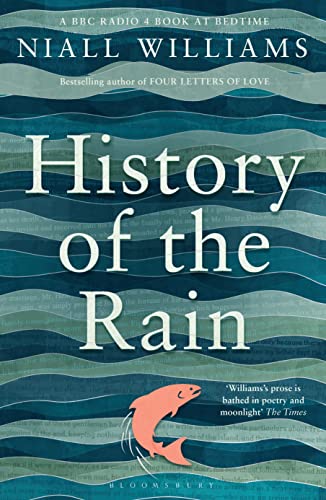
Niall Williams’s History of the Rain and the Book Group

Niall Williams, History of the Rain (Bloomsbury 2014)

Before the meeting: I fell in love with this book at the first paragraph:

The longer my father lived in this world the more he knew there was another to come. It was not that he thought this world beyond saving, although in darkness I suppose there was some of that, but rather that he imagined there must be a finer one where God corrected His mistakes and men and women lived in the second draft of Creation and did not know despair.

That’s nineteen-year-old Ruth Swain, whose mother is a MacCarroll, writing from her sickbed in a book-filled room at the top of a house in the tiny Irish village of Faha, where it has been raining for centuries.

Ruth has inherited her father’s vast library and her head is filled with the books she has read while sick, especially the novels of Dickens. As she tells us the story of her family – her grandparents Irish and English, her mother Mary, her father Virgil and her twin brother Aeneas whom everyone calls Aeny – her prose bristles with references to those books, usually taking the intertextuality to a comic extreme by naming the book’s publisher, date of publication, and its number on her father’s shelves. Her style, as she is told by a schoolteacher who visits her, is ‘a bit Extreme’:

I am that anachronism, a book-reader, and from this my writing has developed Eccentric Superabundance of Style, Alarming Borrowings, Erratic Fluctuations, and I Must lose my tendency to Capitalisation.

Her narrative is indeed eccentric, alarming, erratic, and overflowing with Irish charm. I totally believed in her – so much so that when I reached the Acknowledgements at the end of the story and read Niall Williams speaking in his own voice it was like coming down to earth with a thud.

Ruth’s father is a poet. We don’t get to read a single line written by him, but – in striking contrast to the poet mother in Edwina Preston’s Bad Art Mother (my blog post here) – we have total confidence in his creative process. Here’s a little of the description of the moment when he first begins to create poems, when he is ‘brimming’ after the birth of his children:

There were no words at first. At first there was a kind of beat and hum that was in his blood or in the river and he discovered how somewhere in his inner ear, a pulsing of its own, a kind of pre-language that at first he wasn’t even aware he was sounding. It was release. It was where the brimming spilled, in sound. To say he hummed is not right. Because you’ll suppose a tune or tunefulness and there was none, just a dull droning inside him.

(Page 262)

As well as a multitude of writers, Ruth’s head is filled with the people of Faha, their malapropisms, their idiosyncrasies, their all-knowingness. Possibly because I spent my childhood in the Irish-Catholic diaspora of North Queensland, I didn’t recoil from what you might see as sentimentality in their portrayal, but was delighted by their comic energy. Take this, for example, from the moment when the newborn twins are being baptised in river water in the kitchen of their home:

Everyone closed in around us, everyone wanted to see. It was as if our story was already being told and was moving the hearts of Faha, making people think These two will need help, for right then there was an opening of shirt buttons, a rummaging in handbags, in wallets and coat pockets, a general flurry of rooting about, and then, as the river water was being scooped from the bucket, into our swaddling on the kitchen floor came assorted Miraculous Medals, rosary beads, Memorial cards, brown and blue and green scapulars of various antiquity (and body odour), two Padre Pios, two Pope John Pauls, one Little Flower, Saint Thérèse of Lisieux, Patron-of-the-Missions card, several (because we had been Lost & Found) Saint Anthonys, one Saint Teresa of Ávila, Patron of Headache Sufferers, and from the handbag of Margaret Crowe a sort of crouched-down Lionel Messi-looking Saint Francis of Assisi, all of them well-worn and used and in our first moments in this world falling around Aeney and I now like holy human rain.

(Page 269)

The only reference in that list I had to google is Lionel Messi. All the rest is vintage irish-Catholic. I was so enchanted I barely noticed that horrible ‘Aeney and I’ at the end.

I laughed out loud. I inflicted passages on my long-suffering partner. I cried, though not at the sad bits, which were the only place where the book’s hold on me slackened a little. No, it was when Ruth relents for a moment and lets her awkward and consistently rebuffed suitor wash her hair.

After the meeting: Our host gave us an excellent Irish stew and roast potatoes, which were supplemented by a salad, pastizzi from Newtown and various cheeses, chocolates and ice creams brought by the rest of us.

Not everyone had finished the book; one was still waiting for it to arrive at his local bookshop. Not everyone loved it as much as I did. But we had an animate discussion of the what-about-that-bit variety, and I wasn’t the only one who had been prompted to read sections aloud, as much for the reader’s pleasure as for the listener’s. We all had the impression that the listeners, in this case, enjoyed the experience.

I wasn’t the only one to have wept at the hair-washing incident.

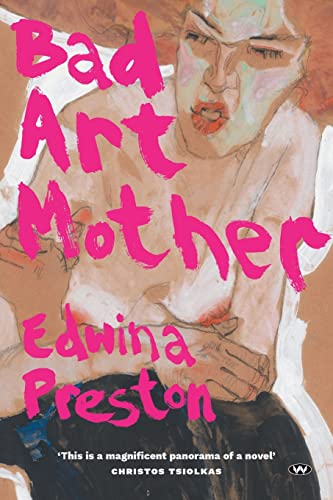
Edwina Preston’s Bad Art Mother

Edwina Preston, Bad Art Mother (Wakefield Press 2022)

Owen’s mother is a poet, pretty much unrecognised in her lifetime. His father runs a restaurant, plus a charity that feeds the homeless, plus an art gallery. His guardians (it’s complicated!) are a successful, wealthy poet and his meek wife who has a knack for ikebana. The most reliable adult in his life is an aunt, a nurse who makes no claims to creativity. In most of his childhood O-yo, as he is affectionately known, rotates among the three households, each its own version of life on planet Melbourne in the 1960s.

The backbone of Bad Art Mother is Owen’s story of his childhood, culminating in the events surrounding the launch of his mother’s only book of poetry. He branches out into two other periods: the moment in the mid 1980s when his mother’s poetry is rediscovered by a feminist publisher, and his comfortable and uneventful life in the present, partnered up with the feminist publisher. Every now and then Owen’s narrative is supplemented by a batch of letters from his mother to her sister that make us privy to the mother’s inner life and to scenes that unfold in Owen’s absence.

So there are two unreliable narrators: one is a child who doesn’t understand the complexities of the adult world (though he does understand more than the adults realise), the other a woman who is increasingly unhappy, self-preoccupied and in denial about her alcohol abuse – though she can be scarifyingly honest about her own appalling behaviour. As readers we’re invited to keep our wits about us, to read between the lines.

I wanted to know what would happen to every one of the novel’s characters, and each of the women in young O-yo’s life offers a different perspective on how to succeed artistically or otherwise under patriarchy (there is a cheerful Lesbian couple), but it’s Veda Gray, poet and Bad Art Mother, whose story provides the narrative spring.

Even though you might expect that young O-yo is most at risk, Veda is really the only character who is in jeopardy. It’s the 60s. Society is getting ready for Germaine Greer and, separately, the beginnings of Women’s Liberation. Veda has read a book by an unnamed American feminist, whom we take to be Betty Friedan, but she is unable to take up the cudgels on her own behalf. She increasingly seems to spend her days at home, drinking, spending less time writing poetry than complaining about the difficulty of being a poet. Somehow she gets a contract with a small press to publish a collection of her poems, but publication, on which her survival seems to depend, is repeatedly postponed. We know it will happen, but we know from a flashforward on the opening page that something will go wrong. There is very real suspense, and the story moves along at a cracking pace to a dramatic climax.

But there are disturbing cross currents .

THE REST IS SPOILERISTIC

For example, there’s this moment early on. Veda is writing to her sister about her conversations with Mr Parish who, we have been told, dislikes abstract art and, presumably, modernist poetry:

We have had several lively debates, such as Ern Malley, that old chestnut, where I find him a harsh critic of MacAuley and Stuart.

(page 35)

Veda misspells both James McAuley’s and Harold Stewart’s surnames, even while claiming a bored familiarity with the Ern Malley affair. Not only that, but she seems to be under the impression that McAuley and Stewart were modernist poets of the sort Parish would abhor, whereas they are militantly on his side, and his harsh criticiism would surely have been for Max Harris, who published the poems.

At first I took these and a scattering of similar ‘mistakes’ for authorial errors that slipped past the copy editor and proofreader, but as I read on I began to think they were indications of Veda’s radical unreliability. We only ever see one of her poems, about which more in a moment. When she’s young, she does ‘second-rate readings in second-rate rooms with second-rate poets’ before giving up because she isn’t getting anywhere, and she receives many rejections from Meanjin. As time goes by though, there are no more attempts to find readers. She has no apparent contact with other poets, except the egregious Mr Parish. She quotes none of her poetry to her sister, the only correspondent we know about. She seems to be unaware that other Australian women poets exist. She does the extremely unrealistic thing of submitting a sheaf of poems to a publishing house and then resenting it when they say they need more to make a book-sized collection.

The real story being hinted at here is that Veda set out to be a poet, but gave up, partly because of sexism but probably because she wasn’t willing to work at it in a sustained way, and wasn’t much good. She settled to a life of posing as a poet (the word ‘posing’ occurs a lot), while sinking into alcoholic chaos, blaming everyone but herself for her lack of success. When, improbably, the book is about to be published, she decides to strike a blow against the establishment by [SERIOUS SPOILER ALERT] altering its opening sonnet so that the first letters of each line spell out a fourteen-letter obscenity. The world comes crashing down around her: the book is pulped, her career as a poet is finished, and her life is over.

An end note informs the reader of the famous occasion when Gwen Harwood slipped a similar sonnet past the editor of the Bulletin in 1961, and quotes from a letter Harwood wrote to a friend. There are two ways of reading this, depending whether you think Gwen Harwood’s exists in the world of the novel. If she doesn’t, then the incident has been transposed – unconvincingly to my mind – to a decade later. If she does, then Veda’s stunt is a mere imitation of a notorious scandal. I’m leaning to the latter reading, partly because the Ern Malley hoax exists so why not Gwen Harwood as well, and partly because Veda’s sonnet is clumsy and stodgy. If it’s typical of her poetry, her rediscovery in the mid 1980s starts to look like a bit of opportunistic pretend-feminist marketing rather than the equivalent of, say, the rediscovery of Lesbia Harford at about the same time.

So this is a book with a hidden narrative, like the cross-dressing story in Joseph Furphy’s Such Is Life. The title of the book doesn’t signify an art-mother who is bad, but a mother who makes bad art. Veda’s story is even more tragic than it seems at first.

The Book Group and George Haddad’s Losing Face

George Haddad, Losing Face (UQP 2022)

Before the meeting: This book is part of the wealth of interesting new writing to come from culturally complex Western Sydney over recent decades. I’ve blogged about some of it, including poetry by Maryam Hazam, Eunice Andrada and Sara M Saleh, and fiction by Michael Mohammed Ahmad, Luke Carman, Felicity Castagna and Suneeta Peres da Costa. I have mentioned George Haddad at least once in this blog, for his short story ‘Broken Zippers‘ in Overland 237. This is his first novel.

Joey is in his late teenage years, part of a Christian Lebanese community in Western Sydney, working in a supermarket and pretty aimless. He’s friendly with Emma, who (I think) is an ‘Aussie’, which in this context means of British or Irish heritage. Joey’s Aussie father has been absent for most of his life. He gets on well with his mother, and their mostly amiable bickering is a key pleasure in the first chapters. Joey’s younger brother occasionally looks up from his phone to join the conversation. Tayta Elaine, Joey’s grandmother and the family matriarch, completes the portrait of a warm, supportive, noisy family.

Trouble starts for Joey elsewhere. He goes to a music festival with Emma, his best friend Kyri, and Boxer, who’s a bit of a bully from school days. The drug-infused euphoria of that event takes a dark turn when Boxer and Emma start to make out, but the real trouble comes a couple of weeks later when Joey and Kyri again go out with Boxer and an even worse bully: the four of them pick up a young woman, Lisa, on the train, drugs are involved, and they sexually assault her. What had been charming and engaging sketch of life in a particular community now coheres into a narrative charged with moral jeopardy.

The story is plainly told. In particular, the story of what happens with Lisa is given without evasive language. Joey is not a witness to the worst parts of what happens, and we are given all the mitigating circumstances, but we do see how he participated in precise detail, including the moment soon after the event when he apologises and she acknowledges his apology. But she goes to the police the next day, and Joey and the others are charged sexual offences. Joey’s friends’ and family’s disappointment and anger leave him isolated, and the approaching trial becomes the focus of the narrative. As readers we see a lot of nuance, but though we feel for Joey, the question of accountability hangs heavy over the story – so that the outcome of the trial becomes a secondary consideration. It’s beautifully done.

Meanwhile, Tayta Elaine’s story unrolls in alternate chapters. Apart from being a widowed matriarch, she is addicted to gambling, and much of her sections is taken up with her internal self-negotiations in which she justifies feeding far too much of her pension into poker machines and committing mild frauds to stay afloat. These sections are much less convincing. I feel they were there as necessary ballast to Joey’s story: his generation isn’t the only one to be morally compromised. But this narrative doesn’t grab with nearly the same force.

While thinking about this blog post, I read a short review of the book by Bri Lee in The Monthly. My impression that she is uncomfortable at being asked to empathise at all with a character involved in sexual violence, but she’s too polite to repudiate the project outright:

Joey believes his part in the crime wasn’t as bad as others. What’s often excruciating for a post-MeToo reader is to try to divine whether or not the author believes in outdated ideas or if it’s just the characters who do. Losing Face walks this very old tightrope: what is the difference between re-presenting the problem and actually critiquing the problem?

This is quite misleading. It’s not just Joey who sees his ‘part in the crime’ that way. Lisa doesn’t want him charged, and police charge him with a lesser crime. This is not to say he’s blameless or that he sees himself as blameless. He’s racked with guilt and doesn’t know what to do. There’s very little resource around for him. Bri Lee concludes her review, ‘Elaine is looking at herself in the mirror at the end of the book. Joey is not.’ We must have read different books. In my reading Elaine has gone even further down the path of addiction and bad stuff has happened to her, but she has little or no insight into her own responsibility for her misadventures (not that we blame her, given her tragic back story): she sees only that men are bastards. Joey, by contrast, has decided to change his life.

I hope it’s not a spoiler to give you part of the book’s final conversation between Joey and Tayta. If a mirror is involved, Tayta may be holding it up, but it’s Joey who is looking at himself:

‘I tell you something, Joey. Deep in the mind, any man from all time, no matter what they like to fuck – women, other men, goats – deep in the mind, they still believe woman is weaker than man.’

She stood up. Joey was empty.

She walked towards the garden and kicked with her slipper at a weed growing from a crack in the concrete until it dislodged. ‘And this is why that shit happen to the young girl in the car park with you and them kleb.’ She sounded like she was swallowing her tears. She bent over, picked up the weed and flung it into the garden. ‘And this is why, all around the world, men always doing shit to women in car parks.’

Joey’s anxiety had indeed lifted like magic earlier, and it turned like magic too.

(Page 256)

Just before the meeting I reread the book’s Prologue, which I had forgotten. It’s in the form of an Arab folktale about a terrorising djinn who agrees to leave the women of a camp alone if they gave her the manhood of all their boys. The women do so, and when the little boys grow up, they don’t grow beards, have no gusto for work and must be led, confused, through the desert.

I went into the meeting wondering what to make of that, and wondering what anyone else had made of Bri Lee’s review.

The meeting: This was the first time many of us had been together in person for a long time. We marvelled at the excellence of the bring-a-plate meal, and the luxury of sitting maskless around a table to eat it.

It took us a while to get to Losing Face. Our host was fresh from a battle with a government department in his local area, and there was much experience-based lamentation about bureaucracies. I was able to relay some wise words passed on to me by an employee of that department who had heard it from an old man when he was young: ‘Always remember that the department has no heart to break and no arse to kick.’

We all liked the book. In the process of discussing it, we came to appreciate the way our sympathies and expectations were managed. At first, the sexual assault scene feels like a nasty incident that may well turn out to be one of a sequence. Joey does his best to reassure himself that he’s a decent person, and as we go along with him, or not, we’re uneasy about the moral universe of the novel. When the police knock on Joey’s door it comes as a surprise, and we’re ambivalent: we’re apprehensive for Joey, who has our sympathy, but relieved that this is not going to be a novel in which the main character descends into callous depravity.

I’ll avoid spoilers, but will say that for such a short novel, Losing Face includes a lot of complexity about moral responsibility and the workings of the law. I’d forgotten some of the surprise twists of the legal proceedings.

Joey’s Aussie father – who turns up when Joey is in trouble – struck a chord with our gathering of mostly Aussie-fathers. A little paradoxically, the Western Sydney setting felt familiar and somehow comfortable to us inner-western Sydney types. There’s a queer dimension to the story, which someone felt was a bit tacked on, but someone with relevant experience said his gaydar went off very early in the book. Someone asked, ‘What will Joey do next?’ and we realised that the ending is wide open. I think we all felt that he’s in the process of changing his life, that he’s not going to just shrug off the whole episode, but we had a number of scenarios.

This month’s Chooser was one of the two who couldn’t make it to the meeting. Sadly he had to bask remotely in the glory of having chosen well.

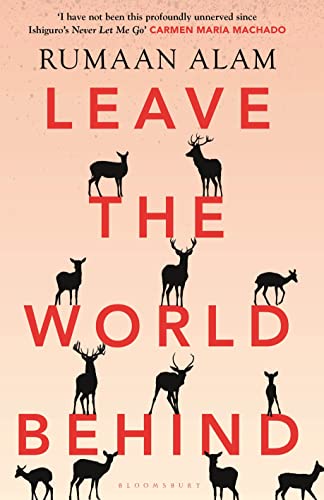
Rumaan Alam’s Leave the World Behind

Rumaan Alam, Leave the World Behind (Bloomsbury 2020)

Just a quick post about this one.

A white middle-class family from Brooklyn – father, mother, teenage boy and younger teenage girl – move into an isolated, luxurious AirBnB place on Long Island. (How do we know they’re white? There are a number of tells apart from their immersion in US materialism – they refer casually to slavery and the dispossession of Native Americans in ways that would be astonishing in the mouths of people of colour or Indigenous people.)

They stock up with luxury holiday supplies and are just settling in on the first night, revelling in the fantasy that this fancy place is theirs, enjoying the delicious discomfort of not being able to check work emails because they have no coverage or WiFi, and generally wallowing in the first night of their vacation while a storm rages outside, when a knock at the door strikes terror into their hearts.

Their visitors are an older African-American couple. We know they’re Black because we see them through the holidayers’ eyes, and that’s the first thing they see. Our heroes’ initial worry that this is some kind of home invasion are dispelled when they are told, and eventually believe, that the visitors are the respectable upper middle-class AirBnB hosts.

The terror never quite dissipates, but its focus shifts. The narrative proceeds painfully slowly. There are weird signs and omens – hundreds of deer in the woods, a dozen flamingoes in the swimming pool, an unexplained noise loud enough to crack the glass in windows. The characters spend most of the novel in various states of unknowing.

It’s like one of those horror movies where there’s a slow build-up until finally the horror is revealed – except in this case we don’t arrive at the inevitably disappointing moment where we see the horror face to face. It’s probably eccentric of me, but I think of Hart Crane’s novel The Red Badge of Courage, where the protagonist has no idea what’s going on in the war in general but can only see what’s going on in his immediate vicinity. In that case, the readers have a wider perspective because we know some of the history. In this one, the narrator breaks the fourth wall with increasing frequency to give broad-brushstroke information about what is happening back home in Brooklyn or somewhere in Florida. We still don’t know the exact nature of the disaster unfolding in the wider world, but we do know the cause of the mysterious noise and – the narrator seems to imply – if we’ve been paying attention to events in real life we should be able to guess what’s happening.

If The Red Badge of Courage is too far-fetched a comparison, how about Luis Buñuel’s The Exterminating Angel. In that movie, the guests can’t go home from a bourgeois dinner party. In this novel they could theoretically leave, and they make a number of sallies forth, but – no spoilers here – there’s an overwhelming sense that these six people are stuck with each other.

The opening pages moved almost unbearably slowly with their attention to the detail of the white mother’s shopping excursion. And once the full complement of characters is present, the conversation tends to repeat. But something in this obsessive listing of brand names and constant return to a handful of observations was generates a cumulative sense of dread, and for me at least it pays off brilliantly as things come closer to boiling point.

Once again, I’m grateful to our Book(-swapping) Club for taking me out of my comfort zone.

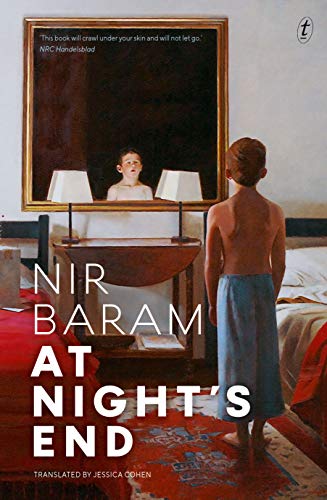
Nir Batram’s At Night’s End

Nir Baram, At Night’s End (2018, English translation by Jessica Cohen, Text Publishing 2021)

I may have missed the point of this book.

It begins with an Israeli novelist waking up in a hotel room in Mexico after appearing as a guest at a writers’ festival. He is disorientated, and decides to stay on in order to track down a young woman whom he blearily remembers saying something to him about the death of his best friend. The friend isn’t dead, or is he?

The following chapters take place by turns in three different time periods: the late 1980s, when the novelist and his friend are in elementary school, creating an elaborate fantasy world and dealing with a trio of bullies; the mid 1990s, when they are in their final year of school; and the present time, in Mexico. There are frequent flashbacks and forward projections in each of the time periods, complicated further by dream sequences, drugged states and possible psychotic episodes. The friendship hits on some hard times. The friend (I think) becomes deeply depressed and after being suicidal for years finally kills himself. The narrator does meet up with the young woman, but as far as I could tell he just gets very drunk and/or stoned with her and another poet. I don’t know if the friend dies before or after their meeting.

Though I spent most of the book in a state of disorientation, the problem wasn’t at the sentence level. The prose, in Jessica Cohen’s translation, is clear and flows easily. It’s just that I never did really get what happened between the two friends, either in the late 1980s, the mid 1990s, or whenever the friend finally died.

The back cover blurb quotes a review by in Haaretz: ‘One of the most intriguing writers in Israeli literature today.’ Yossi Sucary, the quoted reviewer, is probably more dependable than I am. I brought it home from the Book(-swapping) Club. I can’t say it was one of my more successful borrowings.

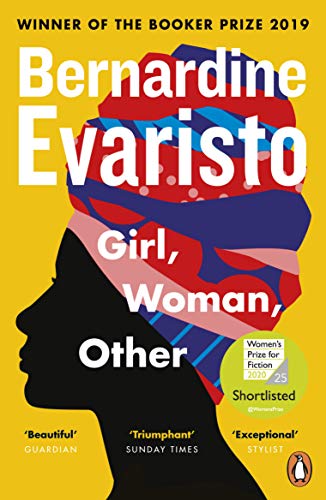
Bernadine Evaristo’s Girl, Woman, Other

Bernadine Evaristo, Girl, Woman, Other (2019, Penguin 2020)

Frank Moorhouse described his early books as ‘discontinuous narratives’. They were collections of short stories whose characters and situations overlapped, but lacked a narrative through-line. In the half-century since those books were published, discontinuity has become much more commonplace in novels, and it’s probably only because Moorhouse recently died that Girl, Woman, Other put me in mind of his term.

The bulk of the book consists of four sets of three short stories. In each set the stories are about three women who are closely related (in one case, two women and a gender-nonspecific person who was assigned female at birth). The main characters are all Black (though some pass for white), and most of them are part of the LGBTQI+ community. They are mothers and daughters, lovers and friends, teacher and students, activists and cancel culture warriors, a playwright, a farmer, a merchant banker. The action mostly happens in England, in the context of feminist and Black liberation movements from the 1960s to the present day. Once you get used to the regular sudden changes in place, time, point of view and voice, the effect is exhilarating.

Of the final two chapters, the first provides a kind of narrative resolution when many of the characters turn up for an event foreshadowed in the first section. So technically the narrative isn’t totally discontinuous in Moorhouse’s sense, but the event is transparently a device to allow characters from different stories to run into each other rather than a real climax. The final section seems to go off in a whole new direction by telling the story of one of the book’s incidental white women characters, only to twist that story back into another narrative strand, to end with a moment that is no less emotionally satisfying for being utterly implausible.

I just read someone online saying they’d heard that ‘the text lacks punctuation’, so they chose to listen to it rather than read it. Well, I’m not saying they were wrong to listen, but the absence of quote marks and full stops – to be precise, the use of full stops only for the ends of sections – is not the annoyance you might expect. Evaristo uses line breaks as a form of punctuation: the meaning is always clear, there’s plenty of white space on the page, and the narrative flows beautifully. I for one was happily seduced.

Honorée Fanonne Jeffers’ Love Songs of W E B Du Bois

Honorée Fanonne Jeffers, The Love Songs of W E B Du Bois (Fourth Estate 2022)

An African-American woman once told me about a research project in which she interviewed Black women in the US who were leaders in a range of fields. Among other things, she asked her subjects what internal obstacles they’d had to overcome to take leadership. Almost every one of them, she told me, had referred unprompted to the legacy of slavery. For someone like me – white, male, middle class, Australian – the US history of slavery was something belonging to the distant past. Not for those women.

The Love Songs of W E B Du Bois, a door-stopper of a novel at nearly 800 pages, has reminded me of that conversation. It tells the story of a young woman, Ailey, who grows up in a small town in Georgia in the second half of the 20th century, goes to a local college and eventually becomes a history scholar. Ailey’s story is inseparable from the stories of her family going back two generations – she is close, for example to her great uncle Root, a fair-skinned African-American who made it in academia when few Black people did; and we follow the tragic loss to addiction of her beloved older sister Lydia.

Then there are the ‘Songs’. These are sections interspersed among the chapters of the 20th century story, in which different, older stories are told in an almost shamanic voice. The Songs begin with the Native Americans who lived in the place where Ailey’s family town was to be built, and take us through the horrors of genocidal dispossession, and then the story of slavery as if unfolded in that place. As you read, you really want to believe that the author is indulging in Hanya Yanagihara–style suffering- spectacular, but this reader at least was convinced that the narratives were grounded in research.

There’s no mystery about the relationship between the narrative threads. They are both connected to the same place in rural Georgia. But when, thanks to Ailey’s historical research, they come together explicitly, the emotional effect is huge. Faulkner’s line, ‘The past is never dead. It’s not even past’ may have become a commonplace, but this book bring is vividly, viscerally home.

I’m not sure why W E B Du Bois is in the title. The great scholar and early advocate of civil rights for African Americans is definitely a presence. Each chapter is prefaced by a quotation from him, and each of the quotations is profoundly insightful about racism in the USA and elsewhere. Uncle Root met the great man in his youth. Characters discuss his writings. But he’s not a character, and I can’t see how the ‘Songs’ can be attributed to him – unless perhaps Honoré Fanonne Jeffers is implying that her own deep immersion in Georgian Black culture and history is due in some large degree to his influence.

It’s a good book to have read when Georgia is again in the news, and not in a good way, when Critical Race Theory is being attacked by legislators who, probably not knowing anything about it, are concerned that it will make white children suffer. This book is a graphic reminder where the much greater suffering has been, and still is. It’s also a riveting read.

Douglas Stuart’s Shuggie Bain

Douglas Stuart, Shuggie Bain (Picador 2020)

This is a Book Group book.

Before the meeting

Shuggie Bain is the story of a boy who grows up in poverty in Glasgow, the youngest of three children. His mother, Agnes, is an alcoholic who is brutally treated by her husband, Shuggie’s father, and then abandoned by him. Once a stunning beauty, she struggles to maintain appearances as she descends into increasingly desperate poverty, alienated from other women and sexually exploited, often violently, by men. From an early age, Shuggie takes on the burden of looking after her, protecting her and trying to make things better. The downward trend is reversed at times when Agnes joins AA, finds part-time employment and has a relationship with a decent man, but there is never any doubt about how her story will end, or that she will take Shuggie down with her. Through it all, Shuggie is singled out by adults and other children as different, not a proper boy – it’s a story of growing up gay.

The Wikipedia entry on Douglas Stuart gives an account of his childhood that could easily be a plot summary of the book. It’s surely no coincidence that ‘Shuggie’ rhymes with ‘Dougie’ (though maybe not in Australian pronunciation, if ‘Shug’ is short for ‘sugar’ as in The Color Purple), and the opening line of the acknowledgements refers to the author’s mother ‘and her struggle’. So the book presents itself as a fictionalised version of the author’s own childhood. As such it’s a valiant work of imagination, wrangling terrible experience into words. I admire it, I read it compulsively, I must have been moved by the horror because when I reached the book’s one moment of genuine tenderness I felt an extraordinary sense of a weight lifting from my mind, even though I knew it was only temporary. But …

… if I hadn’t been reading it for the book group, I would have stopped at page 37, where Agnes is beaten and raped by Big Shug. Really, do I need any more images of that sort lodged in my brain? I did read on, encouraged by the fact that the book won the Booker Prize in 2020, and I’m glad I did, but I found the insistence on the misery of Agnes and every other character in the book disturbing. I can explain what I mean by way of a tiny moment fairly early on. Agnes has regained consciousness after a night of drunkenness, destruction and violence:

Agnes wrapped her lips around the cold metal tap and gulped the fluoride-heavy water, panting and gasping like a thirsty dog. 

(page 72)

She has been beaten up, raped, and shunned. She has done appalling things in her drunken state. Now, the tone of this sentence implies, she has reached such a state of degradation that she drinks directly from a tap, and not only that, but the water has been fluoridated! Where I come from, you don’t have to be subhuman to drink fluoridated water from a cold tap. It feels as if the narrator, if not the book itself, has lost perspective, and I lose faith. It could be that this sentence is a momentary false note. After all, as Randall Jarrell said, a novel is a prose narrative of some length that has something wrong with it. But my uneasy sense that perhaps this was a work of Misery Porn persisted for the rest of the book, even while I engaged intensely with the characters.

Between reading the book and the Book Group meeting: I took the book, and my unease about it, seriously enough to do some counterpoint reading – that is, to read writing that deals with similar material from different points of view. Interestingly enough, the other reading led me to a better appreciation of Shuggie Bain.

1. Jimmy Barnes’s memoir Working Class Boy (link to my blog post here). The early chapters tell of a childhood in a family and community in Glasgow, where alcohol-fuelled violence is as prevalent as in Shuggie’s. Young Jimmy could easily have been one of the boys who terrorised young Shuggie.

They are different kinds of book, of course. Jimmy Barnes can expect his readers to know him as a rock star, and to read the memoir as his back story. As he tells it, the young Jimmy was able to escape from the violence at home, and he went pretty wild on drugs and alcohol himself. Writing as a grandfather, he repents the errors of his youth and writes with generosity and forgiveness of his parents.

The narrator of Shuggy Bain doesn’t have that kind of safe distance from the events he describes. The novel has a visceral immediacy. The account of Agnes’s degradation is told from a point of view not far removed from Shuggie’s own, so the reader is aligned with the helpless child bystander. If the narrator has any distance at all, I imagine it’s that of an adult Shuggie who has escaped Glasgow, and looks back in horror at what he witnessed and endured.

2. Wendy McCarthy on the ABC’s Conversations podcast describes her own response when she saw her father lying drunk in the gutter.

This boy said to me, ‘You know your father’s a drunk,’ and I said, ‘Yep,’ and just kept walking. I learnt something then: I’m not going to carry his shame.

(The link is here. The quote is at 14 minutes and 20 seconds.)

Wendy McCarthy was already at high school when that happened, and had had time to build her inner resources. Shuggie Bain is a novel about a child who didn’t have that chance, and who was caught in the vortex of his mother’s shame.

3. Kit Kelen’s Book of Mother (blog post to come). On the face of it, this poetry collection has nothing in common with Shuggie Bain. Mostly, it plunges the reader into the experience of living with the poet’s mother’s dementia. The son/poet-narrator is an adult, but the poetry captures a kind of mental vertigo that has a lot in common with the way Shuggie is drawn into his mother’s struggles. Comparing the books, I realised Shuggie isn’t just a dreadfully abused child, but he’s also a person of extraordinary heroism. When everyone else abandons Agnes or – in the case of Shuggie’s siblings – escapes her destructive gravitational pull, Shuggie stays, loving her and trying to make things better for her, until the bitter end.

After the meeting: We met in person, all but three who were respectively on the road with a theatrical production, visiting New York for major family event, and home with non-Covid sick children. As usual we ate well and eclectically. Among other things we discussed the role of table tennis for one of us in the process of retiring from regular work; the joy for another at having no income to declare as he too is in the process of hanging up his tools; and our shared relief at having a government that isn’t just about slogans, announcements and cruelty.

The Chooser kicked off conversation about the book by saying that if he’s known what it was about he wouldn’t have picked it, but he’d trusted his wife’s recommendation. I think we were unanimously glad he had, as the book provoked animated, and at times intensely personal conversation.

Many, if not most, had had to overcome initial reluctance that ranged from my own borderline prissiness to not wanting to dredge up memories of a major alcohol-related disruption in his own life.

A number of the chaps said they’d had to take breaks from reading it – one said a dull work on (I think) the energy grid was a perfect palate cleanser. One of the night’s three absentees texted that it was like Hanya Yanigahara’s A Little Life ‘but without the gratuitous violence etc.’ Another absentee sent us a long text part way through the evening, and encapsulated the general sentiment in his summing up: ‘In the end it was really good but hard going. I’m glad it’s over but glad I finished.’

A number of things were identified as having won us over. We agreed that it’s beautifully written – one man said he kept stopping to reread sentences for the sheer pleasure. It feels real – you believe that the author has experienced something close to Shuggie’s life. The narrative has a strong forward drive: as readers we share Shuggie’s hope that Agnes will snap out of the downward spiral, or at least we want it desperately even though we know it’s futile – and we keep turning the pages. The moments of lightness, tenderness and spirited resistance (there are more than the one I remembered) are beacons in the gloom. And we feel strongly for all the characters: Shuggie’s older brother Leekie won more than one heart, and (for me at least) Eugene, the one man who genuinely loves Agnes, tore my heart out when he became the unintentional agent of her destruction.

It’s a terrific book. Next meeting’s Chooser has been urged to choose something cheerful.

Abdulrazak Gurnah’s Afterlives at the Book Group

Abdulrazak Gurnah, Afterlives (Bloomsbury 2020)

Before the meeting: It was my turn to pick the book. I loved Abdulrazak Gurnah’s Gravel Heart when I read it last year, and I chose this one over three contenders because a) I like the idea of us reading work by Nobel Laureates, and it’s so good to have one whose writing is accessible, b) it’s time we read a book by a non-European writer – the last ones were Burruberongal woman Julie Janson’s Benevolence in October 2020, and two months before that In the Country of Men by US-born Libyan-parentage Hisham Matar.

Afterlives is a terrific book. It was longlisted for the Walter Scott Prize for Historical Fiction 2021. That prize was won by Hilary Mantel’s The Mirror and the Light. I have no quarrel with the judges, but my horizons were expanded much more by this book than by that one.

It’s set in the first half of the 20th century in what is now Tanzania and was then German East Africa / Deutsch-Ostafrika. It’s a family saga, a romance, a war story, a picaresque, a colonial tragedy. It tells the huge story of colonial brutality and East African engagement in two world wars, and also focuses closely on the intimate story of a handful of characters. It’s beautifully written, brilliantly visual, and paying attention to the intricacies of language in Africa under colonial occupation.

It takes risks: in the first third of the book a main, beloved character named Ilya disappears – he’s an African who was educated by German missionaries, and decides as an adult to join the askari, the native troops who serve under the Germans. His absence remains an unresolved ache for the other characters and the reader until the final pages, when a character from the next generation manages to unearth his story – and then the book abruptly ends.

In this colonial context, possibly the most painful story is that of the askari or schutztruppe, African soldiers who are brutally treated by their German officers and in turn perpetrate terrible atrocities on other Africans – not unlike the Native Police in the colony of Queensland where my great-grandfather grew sugar in the late 1800s. This passage is from the account of the First World War as experienced by the characters (my emphasis):

Even as the schutztruppe lost soldiers and carriers through battle, disease and desertion, their officers kept fighting on with manic obstinacy and persistence. The askari left the land devastated, its people starving and dying in the hundreds of thousands, while they struggled on in their blind and murderous embrace of a cause whose origins they did not know and whose ambitions were vain and ultimately intended for their domination. The carriers died in huge numbers from malaria and dysentery and exhaustion, and no one bothered to count them. They deserted in sheer terror, to perish in the ravaged countryside. Later these events would be turned into stories of absurd and nonchalant heroics, a sideshow to the great tragedies in Europe, but for those who lived through it, this was a time when their land was soaked in blood and littered with corpses.

(Page 91)

My love for the absurd and nonchalant heroics of The African Queen just became much more complex. After reading this book, it would be hard to think of African suffering, or for that matter African love or prayer (the mosque is significant for some characters), as a sideshow to anything.

After the meeting: There were only five of us, others being out of town with family for Easter/school holidays and otherwise detained – no one in Covid iso this time. We’re still a little bit thrilled to be meeting in person: this is the third time in more than two years. Our host departed from recent bring-a-dish tradition and provided all the food – tuna steaks and a fabulous broccoli salad resting o a bed of tahini. I had been dreading a conversation about the election campaign and had laid bets that someone would predict an LNP win: it didn’t happen until the very end of the evening when there was consensus that it was a toxic topic, press coverage was abysmal and the leaders of both major parties, for different reasons, were invitations to despair.

We talked about theatre – Girl from the North Country, The Picture of Dorian Gray and White Pearl – and other books and podcasts (the ABC’s The Ring In on the Fine Cotton Affair was strongly recommended). There were outrageous travellers’ tales, gossip about the very rich, and general catch-up. When we finally came to the book, we had a terrific conversation, all appreciative.

The book conversation began with a confession: ‘I read it weeks ago, in a single sitting. I loved it but I don’t remember anything of it.’ When asked to say what he loved about it, he who had confessed proceeded to give an account of the book that was much more specific than I would have been able to manage: the detailed descriptions of life in a small Tanzanian town, the sweetness of the characters, the way terrible violence is described but doesn’t dominate the narrative, the overall sense that one is learning history that has been a closed book, the sex scenes – and there was more.

One chap was interested enough in the history to do some research. He produced an atlas and showed us the part of Africa where the action takes place. He had printed out a number of pages on the history of what was German East Africa, and some illustrations of askari in uniform. He was happy to report that the novel’s public events – mainly rebellions and battles – were historically accurate.

One man had read the book twice. The first time, several months ago, he appreciated all the things others had named but was left feeling somehow distanced from the characters – so different from reading that other novelist of colonial pain, Amitav Ghosh. He cared enough to read it again. This time he was no more engaged, but felt it to be a feature rather than a problem. On reflection, he came to understand (I hope I’m representing his subtle comments accurately) that his sense of non-engagement was because we are being shown the deep effects of colonisation on the colonised: the characters are beset by cruelty and oppression on all sides, and they are intent on survival. This means they reach out with kindness to each other – there is an amazing amount of kindness in this book, often in unexpected places – and live very much for what joy and they can find in the present. There’s no room for them to reach out to us readers.

I loved this insight. It helped to see the book as a whole. For example, Hamza, the male romantic lead, responds to most situations with silence. We can tell that he is variously humiliated, elated, disappointed, puzzled, grateful, terrified, but he never communicates it. The narration shows us what happens to him and what he does in response (usually he tends to passivity), but we are not given his internal dialogue. He doesn’t talk to us, the readers.

It also makes sense of the ending. Someone said that the last few pages, in which the fate of Ilya is discovered, feels like a postscript, yet (I think it was me who said this) it resolves an issue that has been hanging from very early in the story. In such a beautifully constructed book, it’s unlikely that this is a rough and ready tying up of loose threads. It’s hard to say more about this without being spoilerish so I’ll just say, with apologies for being vague, that the book’s final sentence, which on first reading felt naggingly anticlimactic, picks up the deep theme the group member identified, and offers a sharp change of perspective on the way the rest of the narrative has been resolved.

Afterwards, I thought it would be interesting to hear a conversation between Abdulrazak Gurmah and Alice Walker, the final moments of whose very different novel Possessing the Secret of Joy make an interesting contrast.

When we arrived the sky was clear. As we left the rain was bucketing down and, just like after the last meeting, the streets were awash.