Category Archives: Page 79

Arundhati Roy’s God of Small Things and the Book Group

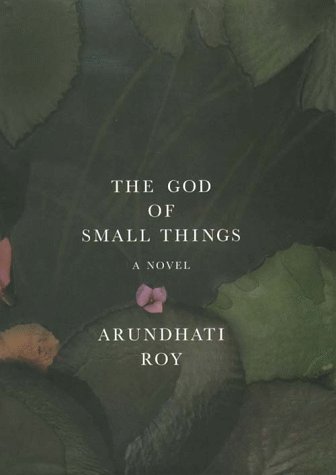
Arundhati Roy, The God of Small Things (Flamingo 1997)
Before the meeting: After Arundhati Roy’s memoir Mother Mary Comes to Me gave us so much pleasure last month, this month’s Chooser met with general approval when he picked the novel that made her famous.

I first read The God of Small Things before I started blogging. Apart from a general sense of having enjoyed it, I retained just one image, of a group of policemen marching in long grass. It turns out that the image comes towards the end of the book, on page 304:

A posse of Touchable Policemen crossed the Meenachal river, sluggish and swollen with recent rain, and picked their way through the wet undergrowth, the clink of handcuffs in someone’s heavy pocket.
Their wide khaki shorts were rigid with starch, and bobbed over the tall grass like a row of stiff skirts, quite independent of the limbs that moved inside them.

There’s so much of the book in those two sentences. The starched shorts, so vividly present and so rich with metaphorical meaning; the initial capitals ‘Touchable Policemen’ marking a childlike personification of key concepts; the river, the undergrowth and the tall grass as part of the physical environment that is such a force in the book. Above all, the complex tone is characteristic: the soldiers are almost comic, puppet-like, yet the reader knows that they are about to do terrible things.

The rest of the book was fresh and new to me. It’s the story of twins Estha and Rahel, their mother Ammu (whose divorced status was scandalous in the mid 1960s, in the Syrian Christian community of their small village in Kerala), and their extended family: Ammu’s brother Chacko, her blind mother Mammachi, and Baby Kochamma. (The text is scattered with Malayalam words, only sometimes translated. I understood ‘Kochamma’ to mean ‘Auntie’, and a quick websearch just now gave ‘a woman who is to be respected like a mother’.) In spite of her cuddly name, Baby Kochamma is a nasty piece of work, disappointed in love by a priest when she was young, and now bitter, moralistic and vindictive. Chacko’s divorced wife, an Englishwoman, comes to visit with her daughter Sophie Mol (‘Mol’ means something like ‘daughter’), who is about the same age as Estha and Rahel.

We know from the beginning that there is to be a disaster. The narrative takes place in at least three time frames: before the disaster, the disaster, and a couple of decades after the disaster. We see Sophie Mol’s funeral before we know who she is, and there are plenty of hints of the other terrible incident – which isn’t revealed until the final pages, just after the scene with the starched shorts.

There’s another moment that has idiosyncratic resonance for me. There are a three or four guava trees on streets near my home. I recently went scrounging and picked from the trees and from the footpaths enough ripe and slightly bruised fruit to make a delicious jar of jam. The unusable fruit on the ground, and there was a lot of it, was a disgusting mess. So it was a personal pleasure when a day or so later, on page 205, Rahel and Estha approach the hut of Velutha, a servant whom they love:

Velutha wasn’t home. <snip> But someone was. A man’s voice floated out from inside and echoed around the clearing, making him sound lonely.
The voice shouted the same thing, over and over again, and each time it climbed into a higher, more hysterical register. lt was an appeal to an over-ripe guava threatening to fall from its tree and make a mess on the ground.

Pa pera-pera-pera-perakka
(Mr gugga-gug-gug-guava),
Ende parambil thooralley
(Don’t shit here in my compound).
Chetende parambil thoorikko
(You can shit next door in my brother’s compound),
Pa pera-pera-pera-perakka
(Mr gugga-gug-gug-guava.)

Exactly what I want to sing to the guavas of Enmore.

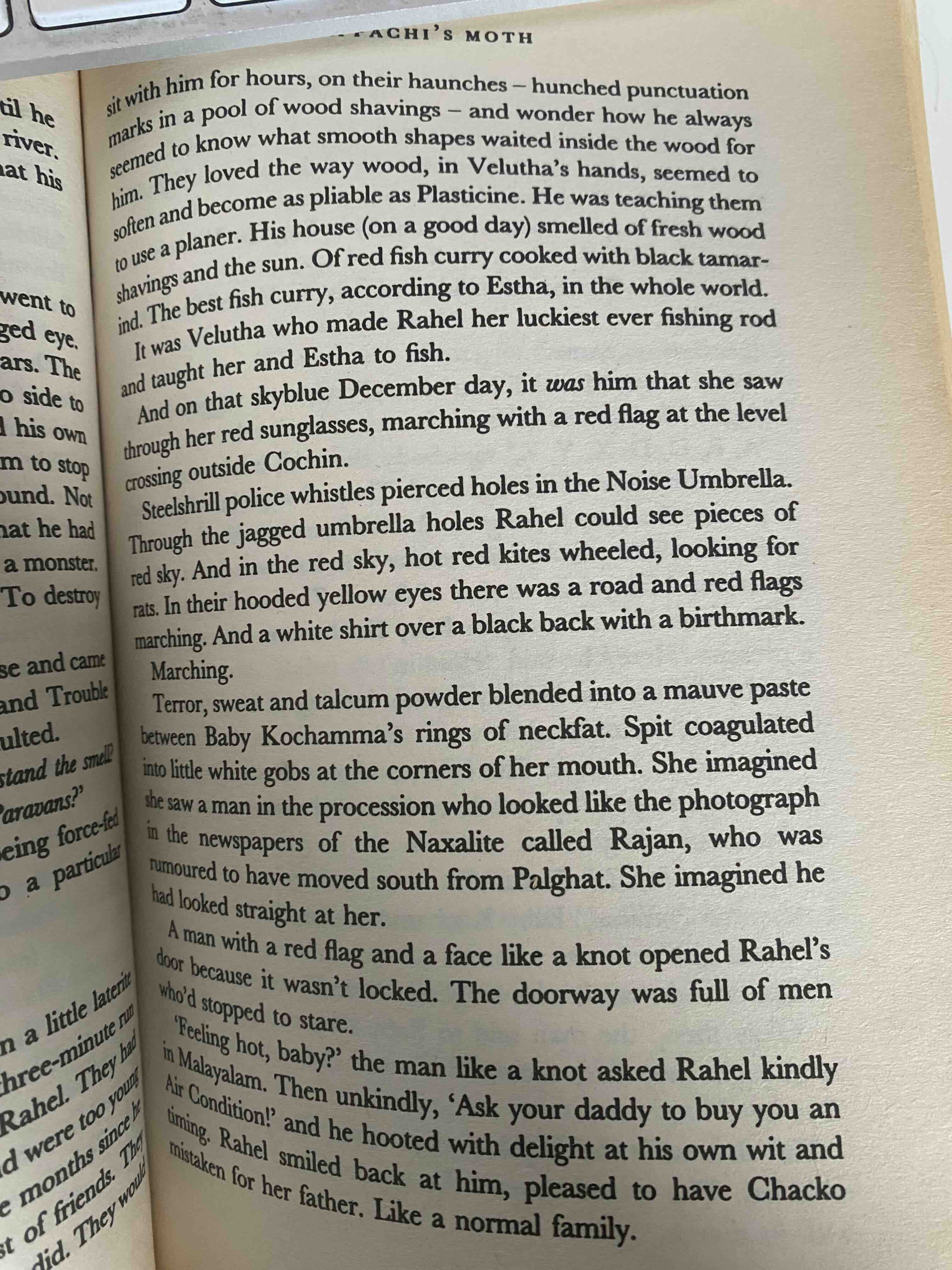
This is a book that cries out for quotation. You can feel Arundhati Roy’s glee as she comes up with similes, malapropisms and mondegreens, little asides, big digressions, wonderful descriptions of people. Page 79* is a good example. As it happens, it starts with Velutha and moves on to Baby Kochamma.

The family are driving to the nearest sizeable town, Cochin, to see The Sound of Music. It’s a long drive, interspersed with flashbacks, flashforwards and songs from the show. At page 78, already running late, they are held up by a demonstration – the street is full of workers, possibly including some Naxalites (the ‘extremists’ who Arundhati Roy was to spend time with in the jungle some decades later), carrying the red flag of Communism. The adults in the car have complex responses. Baby Kochamma is unequivocally on the side of capitalism; Chacko, though he effectively owns a pickle factory, identifies as a Marxist and theoretically is on the side of the workers; the twins’ mother says nothing, but later we realise that she has fellow feeling with the demonstrators. Rahel thinks she sees Velutha – as a former Untouchable, he usually goes shirtless, but the man Rahel sees is wearing a white shirt and waves a red flag.
Though we have met Velutha previously in stories of Ammu’s childhood, it’s here that we learn who he is from the twins’ point of view:

They would sit with him for hours, on their haunches – hunched punctuation marks in a pool of wood shavings – and wonder how he always seemed to know what smooth shapes waited inside the wood for him. They loved the way wood, in Velutha’s hands, seemed to soften and become as pliable as Plasticine. He was teaching them to use a planer. His house (on a good day) smelled of fresh wood shavings and the sun. Of red fish curry cooked with black tamarind. The best fish curry, according to Estha, in the whole world.
It was Velutha who made Rahel her luckiest ever fishing rod and taught her and Estha to fish.
And on that skyblue December day, it was him that she saw through her red sunglasses, marching with a red flag at the level crossing outside Cochin.

Then there’s a characteristic switch in perspective. The omniscient narrator steps in with a premonition. Rahel’s red-tinted glasses fill the world with the colour of danger. Birds of prey wheel above the demonstration, and Velutha’s black back with its distinctive leaf-shaped birthmark becomes a potential target:

Rahel could see pieces of red sky. And in the red sky, hot red kites wheeled, looking for rats. In their hooded yellow eyes there was a road and red flags marching. And a white shirt over a black back with a birthmark.
Marching.

Then the point of view comes right down to a close-up, and some characteristically tactile description. Where Rahel sees a friendly figure in the crows, Baby sees a threat:

Terror, sweat and talcum powder blended into a mauve paste between Baby Kochamma’s rings of neckfat. Spit coagulated into little white gobs at the corners of her mouth. She imagined she saw a man in the procession who looked like the photograph in the newspapers of the Naxalite called Rajan, who was rumoured to have moved south from Palghat. She imagined he had looked straight at her.

I love the final paragraph on the page. Rahel the child is aware that the man with ‘a face like a knot’ means to be unkind, but her preoccupations seize on his unintended normalising of her family.

A man with a red flag and a face like a knot opened Rahel’s door because it wasn’t locked. The doorway was full of men who’d stopped to stare.
‘Feeling hot, baby?’ the man like a knot asked Rahel kindly in Malayalam. Then unkindly, ‘Ask your daddy to buy you an Air Condition!’ and he hooted with delight at his own wit and timing. Rahel smiled back at him, pleased to have Chacko mistaken for her father. Like a normal family

I can’t say I know a lot about India. I’ve never been to Kerala. But at a railway station in Rajasthan, men did stop to stare unblinkingly at the young women in our group. It didn’t feel particularly aggressive or even deliberately impolite. We put it down to cultural difference. That experience helps me to visualise what Arundhati Roy is describing here, and to understand why Rahel isn’t particularly disturbed.

On the next page, the man with the flag turns his attention to Baby Kochamma and speaks to her in English, justifying her terror. But that’s another story, of the many told in this marvellous book.

The meeting: There were seven of us and as always we ate well and enjoyed each other’s company. We spoke as little as possible about Donald Trump, Iran, Israel, fuel and the tendency among younger generations to identify with self-diagnosed mental illness or neurodivergence. We gave passing glances to recent theatre and film pleasures, and to bodily pains, including severe side effects from statins that two of us have experienced, and the satisfaction of a third who convinced his specialist not to prescribe them for him.

One person had said on the WhatsApp group that he’d reach the halfway point of the book and was going to give up. I replied on the group that I loved the book and was looking forward to an interesting conversation – but it turned out that he had read the wrong Arundhati Roy book, The Ministry of Utmost Happiness. He said at the meeting that there are some wonderful passages in it, but he found it very hard going.

Another person had read the right book in the 1990s and hadn’t been inclined to reread it. I don’t think this was from active dislike. As the single parent of a teenager, and the only one at the meeting still in full-time employment, I imagine he doesn’t have a lot of time for reading, let alone rereading.

One person was about halfway through the book, but intending to read the rest and not touchy about spoilers. I’m starting to think it would be good to have a designated non-finisher for every meeting. The non-finisher could then ask questions that lead the rest of the group to think about how things fit together. In this case, there’s a scene where Estha, the boy twin, is sexually molested. Our non-finisher wanted to know if this had a lasting effect on him as it seemed at the time that life just carried on. I replied blithely that it was a bit of a red herring – we were tempted to read this incident as explaining why the Estha we see many years later has become an alienated mute, but the real cause is the much worse incident that happens at the book’s climax. I was gently corrected: Estha’s terror of the incident being repeated set off a chain of events that leads to the climactic incident.

Of the other four, one had read the book reluctantly – feeling that he might have had enough Indian novels for a while (cue a brief digression as we enthused that Amitav Ghosh is scheduled to come to the Sydney Writers’ Festival in May), and it took a while but after the halfway point, once all the characters had been introduced and the plot got moving, the book won him over completely. We generally agreed that it was a bit of a struggle in the first half to keep track of the complex set of relationships. The time shifts, especially in the first half, were often confusing. It’s a book, someone said, that needs to be read in reasonably long sessions – not ten minutes at a time before you go to sleep at night. Nods all round.

Someone else said that when he was struggling with the language he read a passage out to his partner to see if she could make head or tail of it. When he heard the words aloud he realised they were crystal clear. From then on, he slowed down, letting the language play on his inner ear, and enjoyed the experience. (Sadly, he couldn’t find the passage to read it to us.) Conversation hovered around this: not universally seen as a virtue, the book is peppered with writerly quirks, turns of phrase or eccentric punctuation that draw attention to themselves and pull the reader out of the story for a moment. A young writer flexing her muscles, I think someone said. And why not? someone may have said back.

We left our host with the washing up and dispersed into a clear, warm, early Autumn night.


I am a man of settler heritage who has been alive for almost a third of the time that has elapsed since Arthur Phillip claimed this continent for the British crown. The Book Group met on Gadigal land. I wrote this blog post on the land of Gadigal and Wangal, where yesterday’s sudden downpours show no sign of recurring today. I acknowledge Elders past and present and welcome any First Nations readers of the blog.


* My blogging practice is to focus on the page that coincides with my age, currently 79.
Evelyn Araluen’s Rot

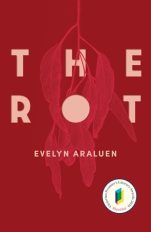
Evelyn Araluen, The Rot (University of Queensland Press 2025)

This is a brilliant follow-up to Evelyn Araluen’s first book, Dropbear. It’s passionately raw, intellectually challenging, and full of rabbit-holes. Araluen says in her acknowledgements, ‘In most ways this is a book for girls.’ She goes on to say, ‘A girl is so many things. Everything, really.’ It’s pretty safe to say that I’m not a girl. But as an oldish man of settler heritage I was swept away.

Alison Croggon in the Guardian (at this link) called it ‘a hurricane of a book’ and says (among other things):

The Rot is an experiential plunge into the nightmare of the present moment, as seen through two centuries of colonisation on this continent. Dark though it is – as dark as our times – it is not hopeless. The book is dedicated to ‘my girls, and the world you will make’: Araluen looks to the ‘Long Future’, a term coined by the Unangax̂ scholar Professor Eve Tuck, for what can be imagined for those who survive colonisation – contingent and elusive as that future might be. At the core of this collection’s bitter truths beats a sublime tenderness.

[In case you need a footnote: Unangax̂ are the Indigenous people of the Aleutian islands. Some of the most powerful moments in Rot come when Araluen wrestles with the implications of Eve Tuck’s thinking. You don’t have to go down this tempting rabbit-hole to feel the full force of the poems.]

Araluen was recently interviewed by Sian Cain for the Guardian (at this link) when she won the 2026 Victorian Premier’s Literary Awards. Here’s a snippet:

She worked on The Rot ‘after work, after dinner, in the bath’ for months, though she now admits that such prolonged focus on such a traumatic subject was ‘irresponsible of me’.
‘I do not recommend drinking wine in the bath and listening to Mitski and crying and calling that a writing practice,’ she added.
The Rot reflects ‘a really panicked, distressed window of a time that I hope we all look back on with horror and despair and a real sense of regret,’ Araluen said.

[Mitski, another of the book’s many potential rabbit-holes, is a Japanese-American singer whose music has been described as a ‘wry running commentary on twentysomething angst, raw desire, and often unrequited love’ (link to Wikipedia article here).]

These quotes give an idea of the book’s tone and its scope, though there’s a lot that they don’t mention. For instance, the genocide in Gaza is a pervasive presence. I recommend that you read both the review and the article in full – and then I hope you’ll decide to read the book.

There’s so much to take in, so much to say, such complexity and intensity to untangle, so many rabbit-holes to be profitably explored. I’ll just offer a small note, keeping to my resolve to focus on one page.

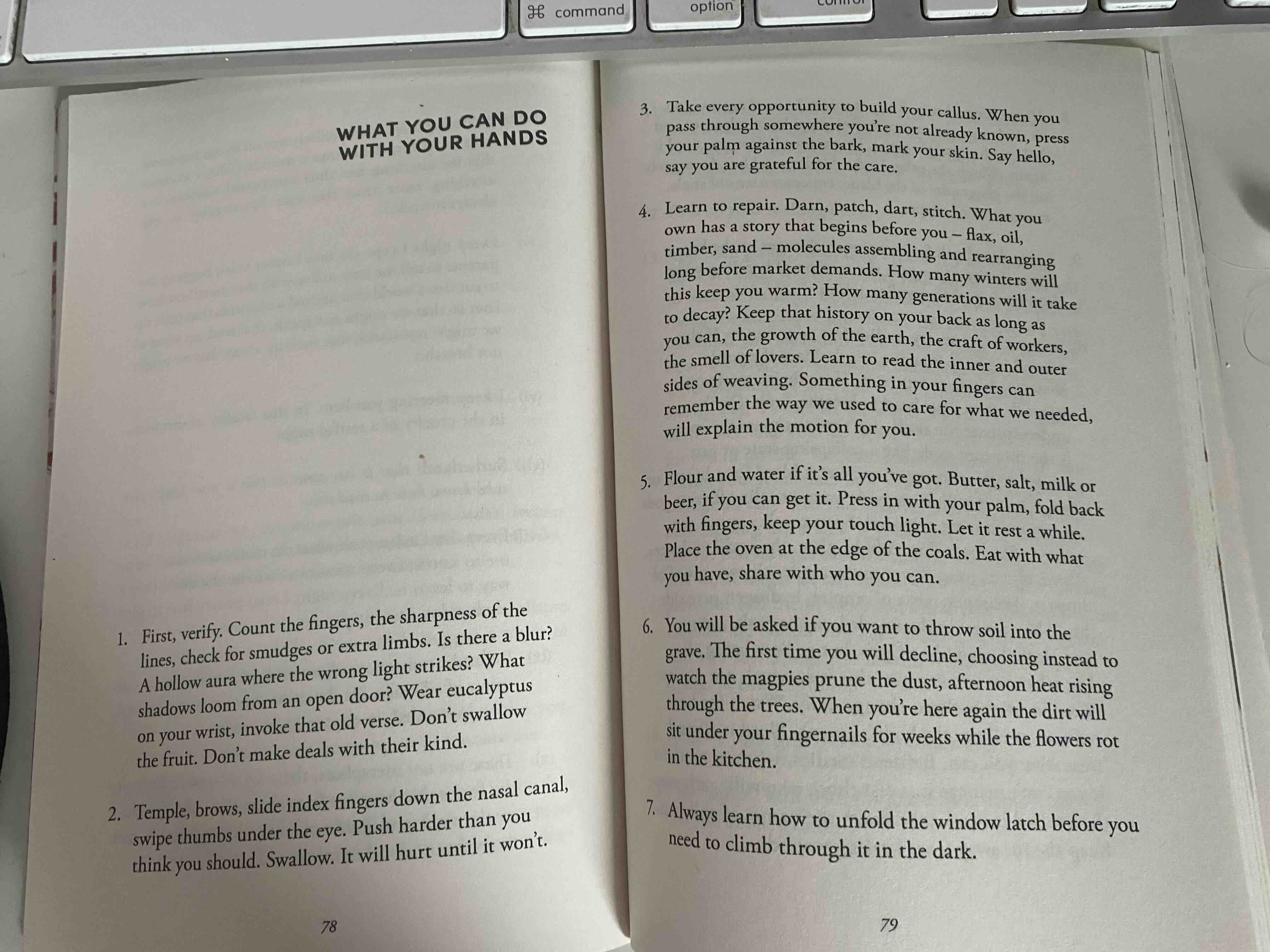
Page 78* is the beginning of ‘What You Can Do with Your Hands’:

Before looking at the poem itself, it’s worth considering it in context. It’s title suggests that it is a direct response to an earlier poem. ‘You’ (page 25) ends:

no less human than yourself. Around us the
world sways, sometimes crumbles. It's not that
you think you can change this, but you need
something to do with your hands.

The hands motif turns up again in ‘Analysis Act Three’ (page 76), which launches itself with a quote from J H Prynne (from his 2022 lecture ‘Mental Ears and Poetic Work‘, another potential rabbit-hole).

Prynne: no poet has or can have clean hands, because 
clean hands are themselves a fundamental contradiction.
Clean hands do no worthwhile work.

Sections viii and ix have this: (Apologies, but my WordPress theme doesn’t allow me to include section numbers as they ought to appear.)

Every day I ask myself what the machine doesn't want 
me to know. Every tomorrow will be the day I find a
way to learn it. Every night I read poetry just to give
my hands something to do.

Refusal, resistance, disavowal and survivance are
tenors of a liveable life. In action they are compromised,
bloody-handed, in the world and of it.

The book is full of theory, grief and rage. But the motif of hands beings it down to earth: thinking and feeling are not enough. We need to work, to engage. Reading poetry can be work. So are ‘refusal, resistance, disavowal and survivance’.

‘What You Can Do with Your Hands’ responds in the form of an instructional poem in 15 sections’. Page 78 has just the first two instructions:

First, verify. Count the fingers, the sharpness of the 
lines, check for smudges or extra limbs. Is there a blur?
A hollow aura where the wrong light strikes? What
shadows loom from an open door? Wear eucalyptus
on your wrist, invoke that old verse. Don't swallow
the fruit. Don't make deals with their kind.

Temple, brows, slide index fingers down the nasal canal,
swipe thumbs under the eye. Push harder than you think you
should. Swallow. It will hurt until it won't.

A quick and dirty summary of these sections would be something like: first, pay attention to your actual hands, and second, use them to become aware of yourself as physically present.

But this is poetry. The words matter. And they introduce an element of the uncanny, something that disturbs the prose meaning. ‘Check for smudges,’ Ok. I can do that, and it is an injunction to self-reflection: smudges – of ink, dirt, foodstuff – will show what I’ve been doing. But ‘check for extra limbs’? The mind goes wandering, and who knows where? Then the questions about light and shade ask the reader to notice their actual context, recognise that they are in a place, in relationship to whatever creates a looming shadow. (In my case right now, the shadows on my hands are cast by light from an open window.)

‘Wear eucalyptus’: fair enough. But what is the old verse we are to invoke? I lay that aside as another of the book’s potential rabbit-holes. If you have an idea, please say in the comments.

‘Don’t swallow the fruit’: I read this as referring to the tale where a person taken to a fairy land must not eat anything if they want to avoid being trapped there forever. That and the final sentence, ‘Don’t make deals with their kind,’ are warnings to keep one’s own integrity against the tide of disinformation and distraction that we live in – ‘Don’t drink the kool aid.’ Already the poem has moved quite a way from literal hands.

The second section comes back to the literal. It insists that the reader notice they are a body: that they push hard to make contact with their own physical existence.

I won’t discuss the rest in detail – the remaining sections cover how to acknowledge place; how to repair; how to cook; how to throw soil into a grave. They cover self-defence, self-care, first-aid, violence, tenderness, and finally connection. Section by section, the instruction form opens up possibilities, creates small and large riddles, resonates. Even Section 12, the shortest, ‘Pick up your fucking litter,’ repays a moment’s attention: the tone shifts and the speaker of the poem becomes for a moment an irritable Auntie. But the comic irritation doesn’t detract from the importance of the advice. Section 14, the second shortest section, is, among other things, a gloss on Section 2: ‘Remove your grip from your own throat.’ It’s one thing to push hard with your thumbs under your eyes until it hurts; it’s a different thing altogether to do violence against yourself, to stifle your own voice. I love Section 15, but it’s against my religion to quote the final line of a poem.

Do read the book if you get a chance.


I wrote this blog post on the land of Gadigal and Wangal of the Eora Nation. I acknowledge Elders past and present, and welcome any First Nations readers.


* My blogging practice is to focus on the page that coincides with my age, currently 78.

The Book Club at Elizabeth Harrower’s Watch Tower

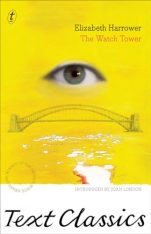
Elizabeth Harrower, The Watch Tower (1966. Text Classics 1996)

Before the meeting: I’m sticking to my resolve to write only about page 78*.

If you want a brief, thoughtful discussion of this book and its place in Elizabeth Harrower’s life work, there are plenty around. I recommend Kerryn Goldsworthy’s review, published in the Australian Book Review in 2012 (at this link). I particularly like this:

It is an accomplished and sophisticated novel of great power and intensity, but, as with most good psychological realism, the reader approaches the final pages with a sensation of exhausted, bruised relief.

It turns out that focusing on page 78 means paying attention to something I saw as of secondary interest on first reading.

This page features the book’s villain, Felix Shaw. (Sadly Elizabeth Harrower seems to have it in for Shaw men: a number of her villains have our family name.) For most of the book its main characters, Laura and Clare Vaizey, abandoned by their mother, live under Felix’s thrall, Laura as his much younger wife and Clare initially as a teenage girl in his care. There’s no romance, no love, and Felix is a misogynist in the full sense of the word – he actually hates women, and constantly torments, abuses and emotionally manipulates the two under his control.

Most of the book focuses on the sisters’ wretched servitude and isolation, but the moments when we see Felix apart from them, like this one, are interesting to revisit. Here he is giving a lift in his battered old car to a former business partner, Peter Trotter, one of a string of younger men whom Felix befriends, entering into financial dealings that invariably end up with him losing money and them leaving him in their dust as their enterprises flourish.

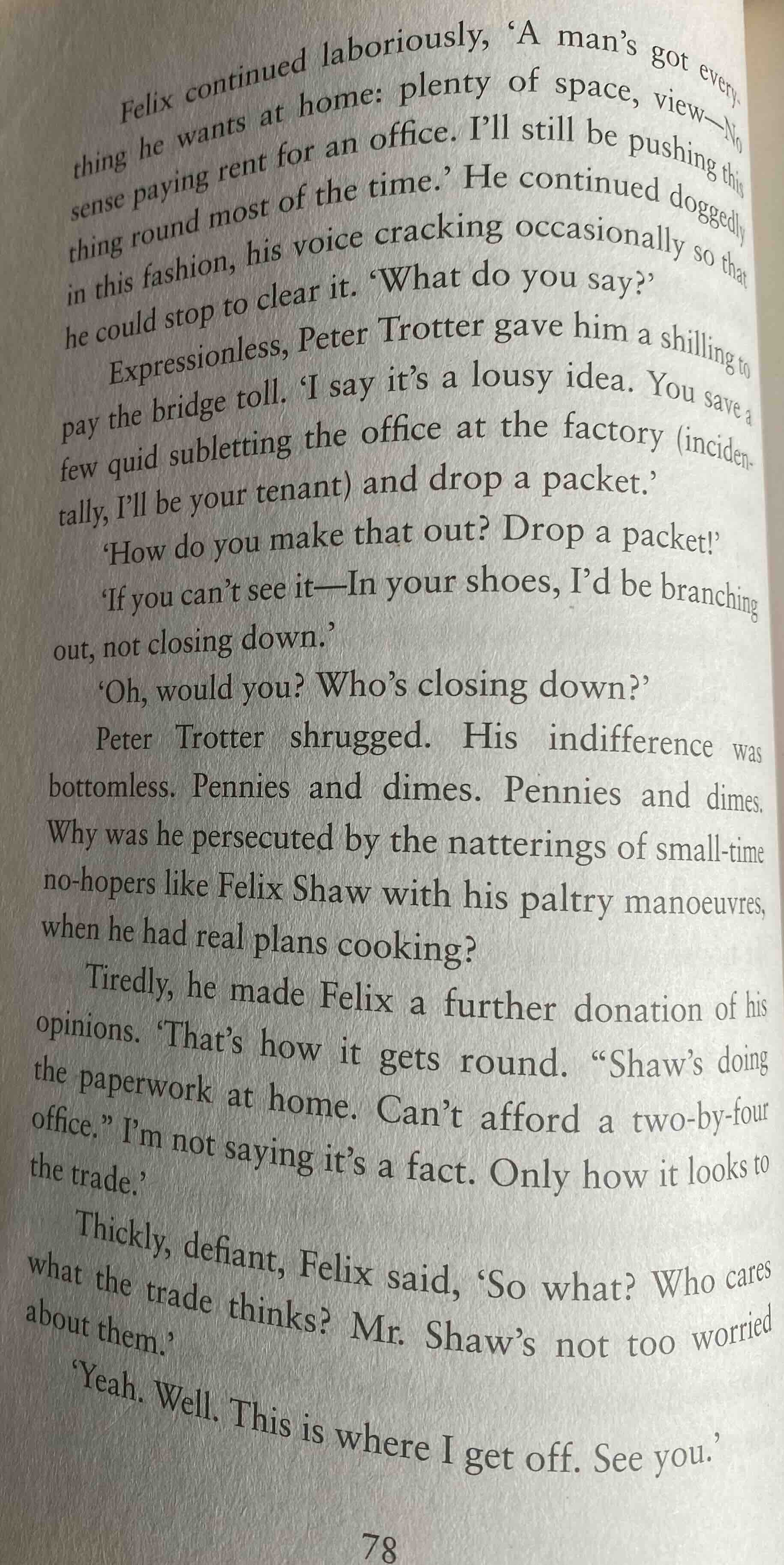
Felix has just explained that he is moving his office from his factory to his home. At least part of his reason, we know, is to intensify what we would now call his coercive control over his young wife. After a bit of bluster, typical rationalisation of a self-destructive action motivated by weird spite, he asks Peter Trotter’s opinion. There is a minutely observed moment of the kind Elizabeth Harrower is celebrated for.

Expressionless, Peter Trotter gave him a shilling to pay the bridge toll.

‘Expressionless’ does so much work there. Even while Felix is pretending that all is well, there is this wordless abject moment when he accepts the other man’s contemptuous financial help. Then Peter offers what the reader knows is a sensible perspective, but which falls on resolutely deaf ears, while illustrating Elizabeth Harrower’s gift for vernacular dialogue:

‘I say it’s a lousy idea. You save a few quid subletting the office at the factory (incidentally, I’ll be your tenant) and drop a packet.’
‘How do you make that out? Drop a packet!’
‘If you can’t see it – In your shoes, I’d be branching out, not closing down.’
‘Oh, would you? Who’s closing down?’
Peter Trotter shrugged. His indifference was bottomless. Pennies and dimes. Pennies and dimes. Why was he persecuted by the natterings of small-time no-hopers like Felix Shaw with his paltry manoeuvres, when he had real plans cooking?
Tiredly, he made Felix a further donation of his opinions. ‘That’s how it gets round. “Shaw’s doing the paperwork at home. Can’t afford a two-by-four office.” I’m not saying it’s a fact. Only how it looks to the trade.’
Thickly, defiant, Felix said, ‘So what? Who cares what the trade thinks? Mr Shaw’s not too worried about them.’
‘Yeah. Well. This is where I get off. See you.’

And that is the end of a relationship.

This page repays a close look. Felix’s reference to himself in the third person makes me realise that Harrower’s depiction of a self-involved, wildly irrational man with bombastic self-belief and demand for absolute loyalty from those he sees as his subjects is alarmingly relevant to the mid 2020s. But it also, surprisingly to me, evokes the reader’s pity for Felix: this man we experience mainly as a controlling monster is, from another perspective, a small time no-hoper with paltry manoeuvres. This pity is dangerous: though she doesn’t use such terms, Laura, terribly abused and exploited, also sees that Felix is a small-time no-hoper, a man whose sometimes alcohol-fuelled violence is born out of deep self-hatred and lack of self-confidence, and her pity for him (she does use that word) is part of what binds her to stay with him.

None of Felix’s attempts to manipulate young men into dependency succeed because on the whole men aren’t vulnerable economically and socially the way young women are in that era. Towards the end of the book, a young male employee named Bernard collapses at work and Felix ‘kindly’ takes him into his home. At last, a vulnerable man to join his toxic household! He deploys the same emotional blackmail and bewildering switches of mood to exert control over Bernard as he has used successfully on Laura, and through Laura on Clare. There’s genuine, chilling suspense: will Bernard succumb or will he escape, taking one or both of the women with him to freedom?

Evidently publicity for the first edition used the word ‘homosexual’. I didn’t pick up any hint that Felix’s yearning for young men was knowingly sexual. But there is something forlorn in the way Felix yearns for friendship with them and in his violent rages at home when they go their indifferent way.

After the meeting: There were five of us. Three had read the whole book, one had reached the 57 percent mark on her kindle, and the fifth – who was the only one to read Joan London’s introduction to the Text Classics edition – hadn’t got that far. None of us found it a pleasant read, but the conversation was interesting.

S– saw Felix as a cipher for coercive control, and admired the way the novel was an early describer of that phenomenon, about which we know so much more now. She hadn’t read Susan Wyndham’s biography of Elizabeth Harrower, which was also prescribed reading for this meeting, and was curious to know how much the book reflected Harrower’s lived experience – it was hard to believe that she didn’t have first-hand knowledge. (A couple of us were able to satisfy her curiosity.) I would have agreed about Felix as cipher if I hadn’t lingered on page 78. I think there was more to him than that, but it’s true that the narration never takes us inside Felix’s consciousness – we see mainly the chaotic vindictiveness of his behaviour.

K– thought the book was not only painful to read but was badly written. (Gasps all round!) In her view, Elizabeth Harrower’s reputation as a great Australian novelist came mainly from her friendships with members of the Australian literary pantheon – Kylie Tennant, Judah Waten, Shirley Hazzard, Christina Stead, Patrick White. (But that’s getting ahead to the discussion of the biography.)

I talked about two moments that produced a frisson in me. The first was the chilling moment when Laura, the older sister and wife of Felix, transitions from being Clare’s ally in victimhood to being his agent in cajoling/coercing her to bend to his will. I thought this was a richly complex turn in the narrative. Others just didn’t buy it. The second was when (possible spoiler alert), starting the book’s final movement, Clare decides to give up the week escape she had been planning in order to care for the ailing Bernard. The profound ambiguity of this moment made the book come alive for me: Clare sees herself as being able for the first time to make a difference to someone else’s life, and is decides to do it with a sense of elation; but the reader sees that for years she has been coerced into putting her own needs aside to attend to Felix’s whims, and it’s simply impossible to tell whether what she sees as her new dignity isn’t a variation on the servitude she has been enduring. In my reading the remaining pages are animated by that ambiguity, and the resolution (no spoilers this time) is perfect. S– thought there was no ambiguity at all: she was just falling into the same trap with a new man.

The conversation moved on to Susan Wyndham’s Elizabeth Harrower: The Woman in the Watch Tower, about which I will blog next.


The Book Club met on the land of the Bidjigal and Gadigal clans of the Eora nation, overlooking the ocean. I wrote the blog post on Wangal and Gadigal land sheltering from unusual summer heat. I gratefully acknowledge the Elders past and present who have cared for this beautiful country for millennia, and welcome any First Nations readers of this blog.


* My blogging practice is to focus on the page that coincides with my age, currently 78.