Lenten vicissitudes at the corner shop

Plywood structures have appeared at the corner. For a little while we saw them, and then again a little while, as it turns out, and we’re not seeing them: a guy with a hammer was taking them down again today. The reason for this seems to be partly bureaucratic hostility on the part of Leichhardt Council (who originally refused to grant permission for a balcony unless the shop owners paid to have the appallingly broken footpath repaired, but lost their case at the Land and Environment Court). But the bureaucracy can claim to be responding to a local outcry: it seems that a mysterious neighbour, hellbent on placing obstacles in the way of the approaching cafe, complained to the Council about having unpainted plywood adorning our corner. So the ply will be painted and put up again, and will stay there for a week or so as the balcony/awning is built.

scaffolding

I can’t give you photos of the transforming interior, but there have been sneak previews, and I can tell you our new corner shop / cafe will have style. Revolver is to be its name.

The approaching latte

Another update has appeared at the corner shop.

Last update.jpg

This, plus the appearance of a tall besser brick wall out the back, behind which extensions to ‘the residence’ have arisen, is the only sign of an approaching opening. Christmas, like September, has come and gone. Easter is now proclaimed as a firm date. In case you can’t read the phone photo, the sign says:

LAST UPDATE
Firstly I really want to thank all the locals who have given me such amazing encouragement & support thru this (two year) ordeal … There were so many delays & problems to overcome I had to go and get a fulltime job to pay bills. THIS IS WHY IT HAS TAKEN US THIS LONG … But now I can happily say the shop is near finished & we will open some time around easter!!! We will be a 40 seat cafe with some general store items for all us locals. Good food, good coffee, good music & good vibes. I see this as more YOUR! place that I will be running. Just a cool local lounge to create a neighbourhood vibe, unpretentious & honest. Everyone asks about the mermaid!! Don’t worry … she stays … And again thanks & love to Annandale for such kind words thru this hard time… it really kept me going. I can’t wait to show & share with you the passion I have created here. I love it so much. Also the group of you that was talking about the ‘billycart race’ … don’t stop … It’s a great idea & we should make it an annual.
much love
Revolver

I don’t know anything about the billycart race, and I guess Revolver is a good nom de guerre for someone called Rod.

So, there’s to be a resurrection at Easter!

Waiting for Latte, episode cxxvii

[Because the older version of this blog has become unreachable, I am retrieving at least occasional posts from it that I see people trying to click on. This is one from January 2009.]

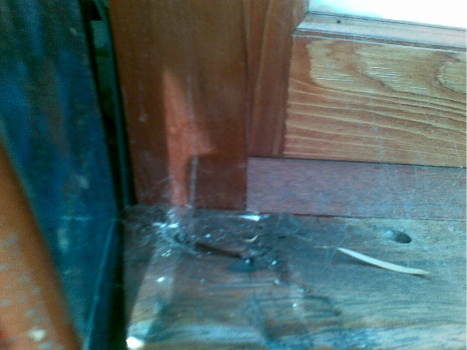
As you may recall, a cheerfully apologetic sign in the window promised wistfully that our corner shop would be opened for Christmas. The sign is still there, and though there has been much progress on ‘the residence’ out the back, there has been no grand opening, indeed no sign of progress in the shop itself. The same sign is there, and cobwebs, dead leaves and dust have accumulated on the window sill.

cobwebs.jpg

L’aspetta continua.

Title thanks to The Witty Knitter

Bookblog #50: U(K)LG

Ursula Le Guin, A Wizard of Earthsea (1968, Puffin 1971)
Ursula K Le Guin, The Tombs of Atuan (1971, Bantam 1983)

(Published 7 January 2009, retrieved 30 July 2021.)

When I was an impressionable undergraduate at Sydney University in the 1960s, the student newspaper Honi Soit published an article by an academic philosopher – it may have been George Molnar — explaining that science fiction was worth reading because in it writers imagined alternative ways of organising society. I wasn’t by any means a hard core science fiction fan, but I had read some. Far from being grateful for a magisterial endorsement of my occasional pleasures, I remember feeling a sneaking contempt for the philosopher who (I thought) had missed the point completely: to argue for the usefulness of science fiction seemed to deny the sheer enjoyment of imagined worlds. I mention the article now because, if I remember correctly, it focused on The Left Hand of Darkness and other Ursula Le Guin books, and may have been responsible for my not having read anything by her until the 1990s when the magical Catwings series came my way professionally and I discovered that she was a lot of fun. (I had read one of the later books in the Earthsea cycle before that, but for a value of ‘read’ that amounts to ascertaining that it expected the reader to know what had happened previously, and further ascertaining that references to menstruation made it unsuitable for most 10 or 11 year olds.) So here I am at last, thanks to my discovery of BookMooch, engaging with her most famous children’s books.

1d4a
0140304770

I don’t have much to say about them, beyond that I found the story completely engrossing, and her manner of telling it magisterial. It’s fascinating to see elements of so many more recent books here. This story is a little like Hamlet – full of quotes. I have resolved never to see the recent TV version, which notoriously made all the characters white (the producers announced proudly that they were colo[u]r blind). It’s not that there’s any kind of profound statement about racism in the book, but the play with skin colour is nonetheless a lovely feature of the characterisation and world building. And one other thing: where did that middle-initial K come from between the first book and the second?

I was going to make this an entry about the whole trilogy, but Penny’s old copy of the third volume of the trilogy managed to go wandering after sitting prominently on the shelf in the spare room for decades, so this is just a note about the first two books, and a promise that I will read and write something about the third. The long wait for the final book of a trilogy, painful though it may be, is after all intrinsic to the experience of reading it. I think of the interminable gaps between The Subtle Knife and The Golden Compass, The Golem’s Eye and Ptolemy’s Gate, Inkheart and Inkdeath (now published but I haven’t seen it), Deep Water and Full Circle (for which the wait has barely begun – Pamela Freeman’s website informs us that the first draft is now with the editor). So I’ll wait until the mage-winds of BookMooch bring me to The Farthest Shore.

The corner shop opening day recedes again

[Because the older version of this blog has become unreachable, I am retrieving at least occasional posts from it that I see people trying to click on. This is one from November 2008.]

Many besa bricks are being assembled into walls in the back yard of the coming corner shop, to be part of the residence. Meanwhile, the shop itself remains opaque to the passerby. This morning an A4 sheet of paper had been wedged into the frame of the boarded-up window:
16112008.jpg

By any other name

[Retrieved from ‘Family Life’ in June 2020]

Today’s Sydney Morning Herald published Nicolas José’s address at the NSW Premier’s History Awards. It’s an interesting address, worth reading in its entirety. My reason for blogging is that José begins with this:

When the landmark Macquarie PEN Anthology of Australian Literature appears next year, it will include, among many other things, an extract from an early Chinese Australian memoir, My Life and Work by Taam Sze Pui, first published in a bilingual edition in Innisfail in 1925.

Taam tells how he journeyed from southern China to North Queensland in the 1870s to search for gold. When he failed as a prospector, he opened a store to meet the daily needs of those in the far-flung district. Later a wife came from China to join him and their family grew with a business that was still flourishing in family hands a century later.

He goes on to describe the influence of Taam Sze Pui’s book on later artists, such as William Yang and Tony Ayres.

The work has been revalued retrospectively, given new meaning and life in a way that subtly reconfigures our understanding of Australian literary history. It forms a connective tissue between past and present that also points forward.

Innisfail exerts its powerful influence on the world of letters once again.

Taam Sze Pui’s name was not forgotten when I was a child in Innisfail, and his shop was still a significant landmark. As I remember it, he was known as Tom See Poy (which is how he’s named in the Australian Dictionary of Biography Online Version), and the shop was See Poy’s, the Grace Brothers of our town. The Macquarie PEN anthology is definitely on my list of books to be acquired.

Asymptotic movement at the corner

[Because the older version of this blog has become unreachable, I am retrieving at least occasional posts from it that I see people trying to click on. This is one from October 2008.]

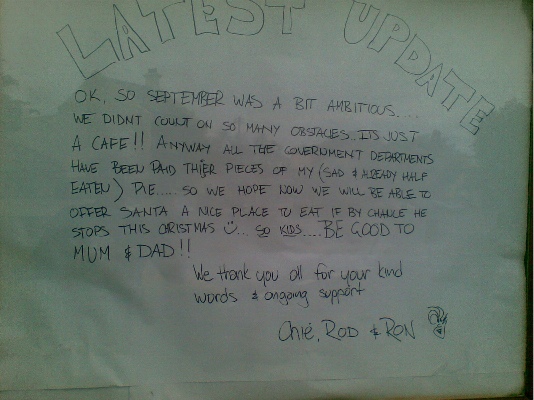
As promised, here’s an update on the corner shop. It’s something like 21 months since it began its painfully slow rise from the dead. Like the June deadline before it, the September deadline has come and gone.

A new bulletin has appeared in the window:

14102008.jpg

I don’t know if it’s significant, but Chie has moved to the front of the list of signatories, and she and Rod have been joined by Ron. I’ve not yet met Chie, and Ron is probably the older man I’ve seen about the place fairly regularly, though given the amount of time that’s passed, it’s quite possible that our prospective storekeepers have a baby or even two. Oddly à propos, Penny and I were talking to an old friend last night who has transformed from a leftist university student into a property developer, and he evoked for us the agonies caused by paperwork sitting for weeks, even months on a desk somewhere in a bureaucracy waiting for someone to pass it on for gazetting. It sounds as if our ever closer but never quite here corner shop may have had its share of such experiences

The back yard has been opened up and is in the process of being paved, or perhaps built on.

13102008(001).jpg
13102008.jpg

And here’s a bonus photo, found in my phone, of a plastic omelette as seen at Narita Airport. Mmmmm!
09092008(001).jpg

Konnichiwa

[Because the older version of this blog has become unreachable, I am retrieving at least occasional posts from it that I see people trying to click on. This is one from September 2008.]

We’re home from nearly four excellent weeks in Japan. As assiduous readers of this blog will realise, my blogging software (iBlog) sits on my laptop, which spent the last weeks on our kitchen table at home. Hence my blog silence except an occasional comment posted from Internet cafes. Now I’m back to a slightly changed world: the ornamental plum tree on our nature strip is in bloom, my elder son has appeared in a small speaking role in a show on national television (he speaks in series 2, episode 4, at about 6 minutes and 30 seconds), a pile of mail has accumulated, the dog is fat and healthy, the corner shop has still not re-opened for business, and the state Labor Party is in deep trouble. And I’ve told you almost nothing of my holiday.

But I don’t intend to leave the trip totally unblogged, partly because I’m an addicted blogger, and partly because I am now convinced that people need to know how fabulous Japan is to visit (unless you’re allergic to seafood, of course). Inspired by franzy’s current-sentence-a day-project, I plan to put up a post a day, reporting on the day exactly a month before — as we left on 15 August, my first travel blog entry will go up on 15 September. I’m setting a time limit for myself, so I don’t get intimidated by the task. And in the couple of days between now and the 15th I’ll post about the books I read, of which there were many, since as it turned out we hardly went out at night at all. Um, so if you were hoping for graphic tales of the famous risqué nightlife, abandon that hope now. Tomorrow: Japan books # 1.

From the archives: Bookblog #31: Past-work-related

Shane McCauley, The butterfly man (Fremantle Arts Centre Press 1991)
Stephen Whiteside, Early Poems and Songs (including “Omeo”) (S Whiteside 2008)

butterflyI had credit to spend at Sappho’s bookshop, and this book leapt to my attention. It cost more than my $8 note, but I recognised Shane McCauley’s name from the ancient days when I was editor of The School Magazine. (Note: I’m not the editor any more. I refer you to the magazine’s helpful tips for manuscript submission.) There’s one beautiful poem in particular, ‘Clouds’, illustrated by Tohby Riddle (in Orbit, November 2003) with a small figure of a child, in the centre of a page filled with dark grass, looking straight up at the viewer, who is positioned as one of the eponymous clouds. I’d never read any of his poems for grown-ups (I hate that word, but adult has been co-opted), and here was a chance. The poems really are for grown-ups: to enjoy them, you need to be either alarmingly well-read or unintimidated by encountering someone who is much better read than you. I’m in the latter category. The range of reference is huge: from an aged Samurai arranging flowers to an Islamic executioner, from Ancient Greece and Rome to Chuang-tzu, from Western Australian landmarks to scientific and mythopoeic cosmology. And I trusted his references: when he attributed thoughts to La Perouse in the long ‘La Perouse to Eleanore’, I believed he had immersed himself in La Perouse’s writing enough to have got it right. I intend reading this again.

whiteside2007During my time at The School Magazine, we published Stephen Whiteside’s poems regularly. And that’s probably the only thing his poetry has in common with Shane McCauley’s. This is his second self-published book, and probably because its back cover includes a quote from this blog, he kindly sent me a copy. Most of the pieces date from the early 1980s when Stephen did a lot of performing (Aha! Another similarity: according to the flap of The Butterfly Man, Shane McCauley was a founding member of a performance poetry group on Perth. However, I doubt if he ever put on a funny hat as Stephen did.) These aren’t poems intended primarily for children, and if I’ve read any of them before it was to reject them (sorry!). They are mostly good rollicking fun with some history, some genial satire, a little bush-philosphising and a touch of melancholy. Many of them latter-day bush ballads, and as an added grace there’s a short, often affectionately deprecatory introduction to each one. You can buy a copy from www.bookstore.bookpod.com.au or, I assume, at Stephen’s readings. (One last note: I suppose I should be glad of it, but I find myself lamenting that in the featured poem about the horribly cold town Omeo, he did not stoop to ‘Omeo, Omeo, wherefore art thou, Omeo?’)

Someone ought to write about this

The New Yorker of 21 July features an article by Jill Lepore about ancient literary battles in the USA.

Anne Carroll Moore (1871–1961), first superintendent of the New York Public Library’s Department of Work with Children, wielded enormous power in children’s literature in the USA during the first half of the twentieth century: ‘Her verdict, not any editor’s, not any bookseller’s, sealed a book’s fate,’ Lepore writes. ‘She kept a rubber stamp at her desk that she used, liberally, while paging through publishers’ catalogues: “Not recommended for purchase by expert.” The end.’

The article tells how E B White’s first book for children, Stuart Little, brought an end to her influence. She hated the book, reportedly writing to White that it was ‘written by a sick mind’, and recommended against it. In 1945, an amazing first print run of 50 000 hit the bookshops, and though ACM’s hostility initially slowed sales down, she was helpless against the tide of its popularity. Behind these events lay a great shift in what was understood to be excellent in children’s literature. Anne Carroll Moore ‘loved what was precious, innocent, and sentimental. White [both EB and his critic–librarian wife, Katharine] found the same stuff mawkish, prudish, and daffy.’

I don’t know if the history of Australian children’s literature boasts any personalities of the magnitude of Anne Carroll Moore or E B White, but I’m feeling impelled to blog a little about some rough equivalents. The School Magazine, subtitled ‘A Magazine of Literature for our Boys and Girls’, was coming into existence at about the same time as Anne Carroll Moore was setting up the Children’s Room behind the lions at the New York Public Library and winning the right for children not only to enter the library but even to borrow books. But who remembers the name of the magazine’s first editor, Inspector Stephen Smith? Since Mr Smith kept fairly busy earning his place in history as an educational mover and shaker, setting up correspondence schools and the like, it probably makes sense to think of Doris Chadwick (1899–1979), generally acknowledged as occupying the chair from 1920 to 1960, as the real first editor.

As far as I know, no one has written much about Doris Chadwick. Yet she did wield significant influence over children’s literature in Australia during the period of Anne Carroll Moore’s dominance in the US. She decided what poems, short stories, songs would be encountered by generations of primary school students in New South Wales. She may not have made or broken careers, but she almost certainly gave thousands of people their first taste of C J Dennis, May Gibbs, Henry Lawson, Mary Gilmore, Wordsworth, Blake, Tolkien, Aesop, as well as stories with titles like ‘Fairy Twee Wee’s Adventure’ (by ‘Neelia’, 1916), which Katharine White may well have found mawkish, or ‘Two Days at a Shearing-Shed’ (W M Corrigan, 1920).

I know two artists who illustrated for Miss Chadwick’s magazine in the 1950s. By that time she was deaf, and very aware of her dignity. When the young Noela Young was ushered into her presence she was asked to wear gloves and instructed to curtsey, which she did to the best of her ability. ‘Ah, yes, I remember you,’ said Doris when introduced to a promising art student, Astra Lãcis. ‘I didn’t recognise you without your hat.’ Astra never wore hats, and this was their first meeting. By that time, without the benefit of a battle in the New York manner, the power was passing to a new generation: Noreen Shelley, assistant editor, was soon to be in charge. She published an excerpt from Stuart Little in 1961.