In the last week and a bit I’ve been to a workshop in the US, which involved large slabs of time in planes and airports and close to 24 hours in a Golf Country Club in Taiwan, the latter because my Taipei–Sydney flight had vanished from the schedule. I’ve had lots of bloggable adventures, but for now, here is What I Read:
Sydney–Taipei: I first met When the Sergeant Came Marching Home years ago in the form of four short stories submitted to The School Magazine. We published them with the series title, ‘Scenes from a Canadian Childhood’, and reprinted them more than once. Now, in hard covers and with an overall narrative arc, they’re still a joy: two boys come to terms with their father’s return from killing Nazis and almost immediately uprooting them and their mother from their suburban lives to take on the life of a struggling farmer. For the book, someone has decided to transplant the farm from rural Canada to US-book-buyer-friendly Montana, but other than that the stories are as fresh, their ironic comedy as laugh-out-loud as ever. (The mother is called ‘Mum’ once, and it’s a rare case of a proofing error – if it is one – that gave me pleasure, providing as it does an archaeological trace of the family’s past life as Canadians.)
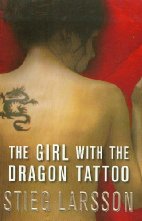
Taipei–Los Angeles, Los Angeles–Boston:The Girl with the Dragon Tattoo was recommended to me as ideal plane reading. It’s a Closed Island Murder Mystery that morphs on its way to a predicable surprise ending into a Hunt for a Serial Killer. The original Swedish title translates literally as something like ‘Men Who Hate Women’, which as you might expect reveals a good bit of the plot. The English title has the virtue of focusing the reader’s attention on the novel’s most interesting character; sadly, the alluringly feminine Quercus paperback cover gives a radically false impression of her. But spiky hair, piercings, and a hint of the sociopath probably wouldn’t have sold as many books. It’s the first of three books, will almost certainly be made into a movie, and was in fact perfect plane fare, and the right length for this trip. I finished it soon after arriving in Boston.
Boston, then Boston–Salt Lake City, Salt Lake City– Los Angeles: I also packed two slim vols of poetry, which also turned out to be perfect travel fare: taking up hardly any room, they provided satisfyingly complete short reads before sleeping the sleep of the sleep-deprived and jetlagged; they were excellent for quelling panic when I turned out to have been booked on a non-existent flight with nothing to do but wait for my name to be called on the hastily found alternative; and when on this flight and in Taiwan I found myself bookless, they bore rereading.
So I consider myself in Jacob G. Rosenberg and joanne burns’s debt, even though many of the former’s poems, despite giving the initial impression that they are a sonnet sequence, read like fairly prosaic notes on the way to his wonderful memoirs East of Time and Sunrise West(as if the gruelling subject matter made attention to anything much more than bald narration seem pernickety), and I read a number of the latter’s offerings with bemused incomprehension. Inspired by Jeanette Winterson on The Book Show, however, I spent a good bit of this leg of my travels memorising poems, and they richly repaid the effort. For the record, I can recite number xii of jb’s ‘diversions’ (beginning ‘The wall longs to be rubble’) and her lovely elegaic ‘ecce’. From JGR’s book, I have taken possession of ‘My Sister Pola’, one of the Holocaust poems.
Los Angeles–Taipei: I don’t suppose Los Angeles Airport is anyone’s favourite place in the whole world, but it’s just moved down a peg or two in my affections. After queuing for maybe a total of an hour to check in, to have my check-in baggage x-rayed, to pass through immigration and to submit to a shoeless personal security check, I discovered that if I wanted a book to read over the next 25 or possibly (and as it happened, factually) 49 hours, I had a grand total of 16 books to choose from. The spanking new collection of David Sedaris essays was the only one that beckoned to me, and it proved to be a diverting read. Sedaris’s charming self deprecation and irony sometimes makes it hard to hear his more serious voice, but it is there, and the book offers meditations on death and lyrical celebrations of his beloved partner Hugh without becoming unreadably earnest. The long section on giving up smoking while holidaying/vacationing in Tokyo is full of delights. I decided two things, however: if possible, I’ll take any future Sedaris aurally, because he’s much funnier and more moving that way; and I’ll read some essays by Montaigne, originator and master of the form.
Taipei: The search for something to read continued in my enforced 24 hour layover: nothing but golf magazines and a 14 year old tourist booklet in the Miramar Golf Country Club, which was also miles from the nearest shop of any kind, let alone English-language bookshop. An anguished email home (thank heavens there was an Internet nook) gave rise to much merriment.
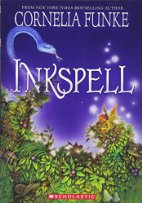
Taipei–Sydney: It was a relief on arriving at Taipei International Airport to discover there was a bookshop, even though it had only a couple more English-language books than LAX: the choice boiled down to The Kite Runner for 530 new Taiwan dollars or Inkspellfor 350. I opted for the children’s book, sequel to the marvellous Inkheart. I’ll write about it when I’ve read more than 50 pages (because, yes, I slept, and even watched a movie).
[I originally posted this on 10 June 2008. I’m making it public now as it’s relevant to a piece I’m writing about the Voice Referendum. 31 August 2023]
OK, I’ve seen the light. Instead of a marathon post at the end of each month about the books I’ve been reading, the plan is now to post entries much more frequently – which reflects more accurately the way those longer posts (20 of them by my count) were composed. I don’t know whether I’ll do a post for every book I read, or a weekly post, or something more idiosyncratic, but the posts will be shorter and more frequent. They won’t be reviews, though if I I feel the urge to write a review I won’t necessarily resist it. My aim, as with the longer posts, is to keep some kind of record of my reading. If I was commenting on paintings visited, I hope I would be doing something less like an art gallery audio-guide and more like the Dear Art Please Touch Me project I heard described on Radio National’s Artworks recently. That project, created by two young artists, Danielle Freakley and Elizabeth McGechie, is an audio tour of the National Gallery of Victoria in which you hear a soundscape of ordinary people giving their idiosyncratic responses to the art. In my case, I do hope you’ll add your own comments, idiosyncratic or otherwise.
I’m kicking off the new regime with Kay Anderson’s Race and the Crisis of Humanism (Routledge 2007), winner of the 2008 Gleebooks Prize, one of the NSW Premier’s Literary Awards. I wouldn’t have noticed the book if I hadn’t been pointed at it by the awards. I wouldn’t have bought it and started reading it if I hadn’t been so taken with Raewyn Connell’s Southern Theory earlier this year, and consequently been interested in the impact of early European–Aboriginal encounter on European theorising, which is pretty much the concern of this book. And I wouldn’t have persisted with its dense academic prose, which fairly bristles with learned referencesand also with the proofreading oversights and chaotic use of commas that seem to be inevitable in such publications, if there wasn’t a promise of fresh insight into the nature of racism.
I’m glad I read it, because it introduced me to apparently vast scholarly conversations about race and racism, and about the history of people’s understanding of what a human being is, among other things. Its central argument is something like: let’s agree that the concept of innate differences between people of different ‘races’ was developed over the last couple of hundred years, and had the function of rationalising the genocidal brutality of nineteenth century colonialism; but describing its function isn’t a full explanation of where it came from; European thinkers took their own specific society to be a universal human condition, and as they encountered different-looking and differently organised peoples their understanding of what it means to be human was challenged; rather than change that understanding they found a series of ‘scientific’ ways to define the new people as lesser versions of human. Something like that – but a lot more carefully argued, and more interesting. Kay Anderson brings a coldly analytic eye to some fairly monstrous pieces of writing, all the more monstrous because I recognise in a lot of them a kind of full-blown, explicit version of ideas that still float around today, some that were presented as simple fact in my childhood education.
At some points in the book, I felt an almost physical pain at the absence of Aboriginal voices. As the European scholars – few of whom had ever visited Australia – argued back and forth about the status of ‘the Tasmanians’ and ‘the Australians’, collecting their skulls and measuring them obsessively, it was almost impossible not to think of the deep satisfaction of a man and woman in a recent Awaye program describing sleeping in the same room as ancestral remains reclaimed from a European museum before loading them onto a homeward-bound plane. As the scholars pontificated about the inevitable ‘extinction’ of the Tasmanian Aboriginals, I recalled James Boyce’s account in Van Diemen’s Land of the machinations, negotiations, lies and evasions of the British Governors who oversaw the massacres. As they rabbited on about the ‘unimproveability’ of the Australians, I was glad to have read Inga Clendinnen’s meticulous attempts to retrieve from the colonisers’ own records an account of the first years of contact in New South Wales from the point of view of the invaded. And once or twice, when something felt personal about someone I know, I almost shouted out loud, ‘Shut up! Just shut up!’ Kay Anderson has a much stronger stomach that I do: she actually goes in and tries to understand where the vile stuff comes from.
[Because the older version of this blog has become unreachable, I am retrieving at least occasional posts from it that I see people trying to click on. This is one from October 2008.]
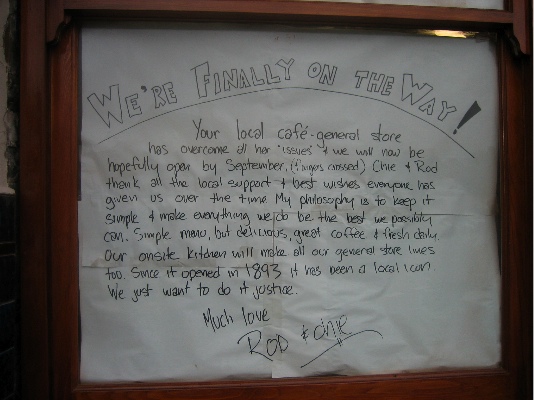
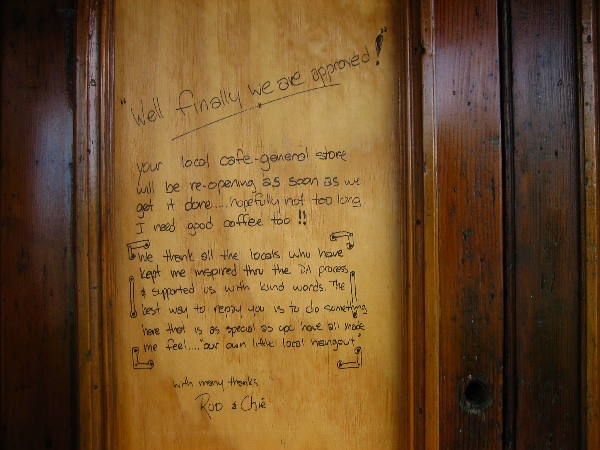
>It’s been a while since I’ve posted anything about our block’s long, slow journey towards once again having a functioning corner store. There have been signs of progress lately. The windows have been replaced, or at least had their woodwork scraped back and varnished, and noises and lights have been reported at odd times of the day and night, mostly on weekends. Sadly, before I could have a stickybeak and maybe take a photo of developments, all the windows had white paper sticky-taped to their insides, so developments have been shrouded in mystery … until today, when a news bulletin appeared on one of the papered windows:
I don’t know that I’d thought of the corner shop as an icon, but it certainly has been a treasured institution, and I’m sure I’m not alone in thinking: ‘Come, September!’
[I posted about this in my old blog in 2008, and am retrieving it to this one because it mentions Somewhere Towards the End by Diana Athill, who died in January, and whose more recent book of essays, Alive, Alive Oh! I plan to blog about soon – JS, 31 March 2019]
As I mentioned last month, I started reading Schulz and Peanuts to check its suitability for a young fan. I’m happy to report that in general it passes with flying colours. A young woman has a termination, and the break-up of ‘Sparky’s’ first marriage is gruelling, but these are both handled with a good bit more tact than you’d find in many YA novels.
Every week, for just months short of 50 years, Charles M Schulz sat at his drawing board to produce six daily strips and a longer Sunday piece. He inked every line himself, and penned in every letter until his final stroke meant that the speech balloons in the very last frames were filled by computer-generated lettering. Peanuts was the most important thing in his life; he hated being away from home, and died the day his last cartoon was published.
This isn’t a tale of heroic physical exploits or grand public gestures, but David Michaelis seems to have interviewed every living soul who had a meaningful connection with his subject, from the psychology student who gave him an impromptu – and effective – counselling session on his agoraphobia at a tennis tournament and never had another conversation with him, to Joyce nee Halvorsen, the main model for Lucy, his first wife and the mother of his many children (one of the best bits of the book could have been titled The First Wife’s Story).
The result is a fascinating, many-faceted portrait of an artist and of a man. Peanuts strips are scattered through the pages, not as decoration but as integral elements of the narrative. Cartooning was not only Schulz’s life work, the fulfilment of a central ambition; it was also, dare I say, a spiritual discipline by which he found perspectives on the difficulties and dilemmas of his life (and the lives around him) that allowed the release of laughter. While Michaelis is very bold (and repetitive) in some of his psychologising, I found his thesis persuasive: that what we common or garden readers received as Schulz’s comic reflections on life in the abstract were often if not always born out of particular moments of pain or joy. Schulz seems to have been an excellent exemplar for Neil Gaiman’s advice on how to deal with trouble: Make good art.
Michaelis places Schulz interestingly in the history of comics – though he barely mentions comic books as opposed to strips, and surely the moral panic in the 1950s epitomised by Fredric Wertham’s Seduction of the Innocent (which led to a nun confiscating a Phantom comic from me in Grade Three, and to our teachers’ recommending that we read the boring Catholic comic Topix) had something to do with the runaway success of Schulz’s wholesome creation. It’s surely not entirely coincidence that for a time in the 1940s, before he got his big break, Schulz did lettering for Topix.
[I passed the book on to my young friend, whose mother reports that after dipping into it he said, ‘It’s not all that interesting to me, even if it is to Jonathan. But he reads everything.’ Then, softening the blow, ‘Some of it is pretty good.’]
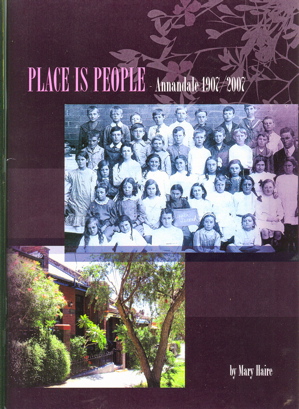
Place is People is a strange little book, neither an attractive collection of photographs to introduce the suburb to visitors nor a quick historical overview. It’s got elements of both those, but is something more personal and less orderly than either; if it was even more personal, it might have been an extended prose poem, but it isn’t quite that either.
Mary Haire leads walking tours, and the book has something of the serendipitous feel of such tours: here’s a little girl walking to school; let me tell you about a boy that age who went to the same school a hundred years ago. I know more about my suburb’s history having read it; some errors have been corrected, and some tantalising trails laid in my mind: Cardinal Freeman was born here, for instance, and the young woman at the florist’s is a single mother. How can I put those two snippets in the same sentence, you ask? I plead that the book sets a precedent with its gloriously unconcerned potpourri approach to its subject.
Talking at Gleebooks recently, Helen Garner paid tribute to Elmore Leonard’s essay, ‘Ten Rules of Writing‘: she has his sentence, ‘If it sounds like writing, I rewrite it,’ on the wall above her desk. In The Spare Room, she has given us a feminine Elmore Leonard story: it’s about the emotional tangles between two women, or at least those tangles provide the language for its telling, but it has the clean lines, the sure forward movement, the lack of hooptedoodle, that give such pleasure in Leonard’s tough-guy narratives from The Tall T to, say, Pagan Babies.
It’s a very quick read, and an intense one. There’s plenty of complexity, some of which I’ve found making itself known to me weeks after finishing the book. For instance, ‘Helen’ the character, who is manifestly a version of Helen the writer, claimed my allegiance and assent to her judgements while I was reading, but has since come to seem much less reliable, much too caught up in her own emotional reactions to be able to give us the full picture (some of which the book gives us in spite of her). It’s a magnificent achievement.
I doubt if David Campbell (1915–1979) is still studied in Eng Lit courses at many Australian unis, but I hope he is fondly remembered and occasionally reread by more than just me. He and Martin Johnston share a posthumous moment in John Forbes’s elegiac ‘Lassù in Cielo’; he cropped up in a footnote in the John Manifold collection I read last month; a recent Poetica featured his correspondence with Douglas Stewart; lines and images from his poems arrive in my mind unbidden from time to time.
Most of the poems in this selection are a strange mixture of the bucolic and the erudite (and just in case I’ve misused those words, I mean rustic and scholarly), and there’s a pleasant music to them. When I read the sequence of twelve twelve-line rhyming poems of ‘Cocky’s Calendar’, I found myself wondering how he managed to pick up his pen again after writing something so wonderful. Back in the early 1970s, in an Aust Lit seminar on this sequence, a student from North America totally didn’t get them: while the rest of us were being drawn into the poetry’s intensely personal relationship with the landscape, he lost patience altogether and said the whole thing read like verse you’d find on a Norman Rockwell calendar. I thought then that he was missing something, and I find I still do. This is the ninth poem, for September:
Under Wattles
Now, here and there, against the cold,
The hillsides smoulder into gold
And the stockman riding by
Lifts to the trees a yellow eye.

It's here the couples from the farms
Play in one another's arms
At yes and no – you'd think the trees
Sprang from their felicities.

So may our children grow up strong,
Got while the thrush drew out his song,
And love like you and I when we
Lie beneath the wattle tree.
How about that present tense ‘lie’, eh?
I think the sequence as a whole speaks to me so strongly because of my father. At a family gathering once, another farmer, of a younger generation, said something about the boredom of spending a whole day driving around a paddock in a tractor (this was before the days of air-conditioned tractor cabins and iPods). When my father said mildly that he didn’t get bored, one of my female cousins asked him what he did with his mind when he was out there all day. As he drew breath to answer, my mother came to the rescue by changing the subject (‘Oh Jenny, you know you’ve been asking me about tatting, I have a pattern here I can show you’). Probably to his relief, my father didn’t get to answer the question. I like to think that David Campbell’s contemplative poems, even though his is a sheep property while my father grew sugar cane, provide some version of what my father might have wanted to say back then over tea and scones.
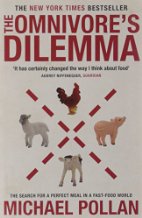
With The Omnivore’s Dilemma I was back to farming, in three categories: industrial, of which I read with a mixture of horror and curiosity; pastoral, which is not synonymous with ‘organic’, but tends to have the virtues claimed for it; and personal, in which the author creates a meal from things he has personally grown, hunted and killed, or foraged. I don’t know that anyone could read this tremendously engaging book without changing the way they think about food. It’s very heartening that it was a New York Times best seller. If you want a quick look at the central part of the book, which deals with ‘intensively managed grazing’ or clever grass farming, here’s a video from Michael Pollan’s recent TED talk:
The book integrates into its narrative any number of lively essays: on the ethics of meat-eating (in which Pollan engages with Peter Singer), the joys of hunting (ditto Ortega y Gasset), attempts at humane design in modern abattoirs (Temple Grandin), the US domestic and international politics of corn (in which he doesn’t discuss the so-called Free Trade Agreements that leave the US free to subsidise its grossly inefficient corn agribusinesses while preventing other nations from continuing with similar protections, but he makes their absurd brutality abundantly clear), on just about anything you can think of that’s related to his central question, ‘What should we have for dinner?’ Some of it is very funny. Some is inspiring. Some horrendous. All of it is engrossing.
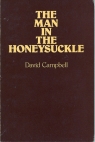
I hadn’t read David Campbell’s The Man in the Honeysuckle before. As with Selected Poems, I’m fairly indifferent to the learned bits, mainly translations and imitations from the Russian, but some of the lyrics, especially the Aust Pastoral pieces, are extraordinary. The book was published posthumously, and it’s hard not to read a number of the poems as being poignantly suffused with a sense of death as imminent. ‘Crab’, ‘The Broken Mask’ and the whole ‘With a Blue Dog’ section stand out for me in this first encounter. How’s this:
Wind in Casuarinas

Camped under the she-oaks
With a dog and swag

The woman a white sapling
A straight flame
Blown all ways
And the children off
On their several roads

Lives rounding like river stones
Or washing out in wheel ruts

A high sky over tree and hill
And the clouds taking fire
I am spread out I burn
Yellow and rose – blessing and blest
A still flame in the arms of the she-oaks

Life butting into the world
With five wants and a howl
And shambles out with a blue dog.
I want to put ‘five wants and a howl’ right up there with ‘helpless, naked, piping loud’.
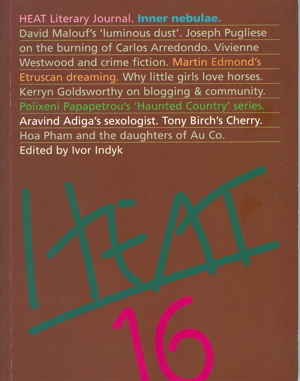
I don’t imagine Elmore Leonard would care much for this Heat. There’s hoptedoodle galore … though generally very high quality hoptedoodle. Ironically, the one article that seem to me to be 90 percent hoptedoodle is by a crime writer whose point seems to be that crime fiction has advantages from being bound to an absence of hoptedoodle (but maybe I was just irritated because her essay on the relationship between genre fiction and literary fiction totally ignores the existence of children’s literature and science fiction).
There’s a terrific piece on blogging by Kerryn Goldsworthy, not a hopt or a doodle in sight; a lovely pairing of a story by Eva Sallis (‘Abattoir’) and an essay by Elizabeth Campbell (called ‘Why Little Girls Love Horses’ on the contents page but ‘Envy Worship and Passion’ on its own title page); chiming mentions of the catacombs of Paris, of which I’d never heard, first in one of Jennifer Maiden’s still-intriguing George Jeffreys–Clare Collins poems and then in an engrossing essay by Sarah Knox about researching historical novels, her own and Hilary Mantel’s; and a number of memorable pieces on aspects of migration: Elisabeth Holdsworth’s memoir ‘New Holland’, a short story by Hoa Pham, poems by Ali Alizadeh (on his unborn baby) and Peter Skrzynecki (on his late father). There’s lots more. I’m a happy subscriber.
I understand that it must be a nightmare to copy edit a magazine like this: so many words, so many different voices, so little time. But there are enough lapses to present a significant obstacle to the reader, at least to this one. At one point, havoc is ‘wrecked’; as something wreaks havoc just a few pages later in the same article, it seems likely that the error resulted from an editor’s dependence on a spellchecker rather than ignorance. In the sentence, “The memoir becomes a book about illness to many reviewers; a ‘survivors’ tale; a plumbing of the issue of women’s health, and the continuing masculinist paternalism of the public health system” it looks very much as if the apostrophe after survivors was misunderstood by someone who inserted another before it to make it function as a quote mark; and the comma after health almost derails the sense. I don’t want to go hunting for similar moments, but the erratic comma and absent apostrophe in ‘reconstruction, so redolent of the historian’s duty, and the re-enactors fancy’ just leapt up at me from further down the same page (p 172). This might be just the irritated snitchiness of an underemployed pedant, but in this context it becomes hard to tell if the truly eccentric punctuation in a number of the poems is what the poet intended or the product of editorial inattention.</curmudgeonly grumble>
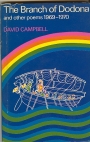
How could I resist reopening The Branch of Dodona, my only other David Campbell book? This one had pride of place in the bathroom for a week, to allow for contemplative reading in short bursts. Again, it’s his farming poems – in this volume, the ‘Works and Days’ sequence, with its love–hate relationship to sheep – that speak most strongly to me. Even his ‘My Lai’, which I remember him reading at Vietnam Moratorium Readings in another age, works so powerfully because of the farmer-to-peasant solidarity it embodies:
I was milking the cow when a row of tall bamboo
 Was mowed by rifle fire
 With my wife and child in the one harvest,
 And the blue milk spilt and ruined
I’m not sure what the friend had in mind who gave me Diane Athill’s reflections on old age, Somewhere Towards the End, as a present for my 61st birthday. As Ms Athill is almost exactly 30 years older than me and still going strong, I’ll assume she wasn’t hinting it’s time I hang up my spurs.
In terms of my current reading, the book’s matter-of-factness, its almost belligerent steadiness of gaze play as a sober counterpoint to the rage and evasion of The Spare Room: both books generate what Athill calls an ‘addictive excitement of the mind’, and they speak to each other. Ms Athill’s brief reference to Hilary Mantel’s A Place of Greater Safety endorses Sarah Knox’s praise of it in her essay in Heat. The book has in spades a (to me) miraculous quality that I think of as Protestant integrity, a quality also displayed, ineffably, in the manner of my friend J’s leavetaking. I wouldn’t mind having a mind like Diana Athill’s when I’m 90. She manages to be remarkably cheerful about things usually discussed, if at all, in gloomy mode. One chapter begins, for example (the emphasis is mine):
When you begin discussing old age you come up against reluctance to depress either others or yourself, so you tend to focus on the more agreeable aspects of it: coming to terms with death, the continuing presence of young people, the discovery of new pursuits and so on. But I have to say that a considerable part of my own old time is taken up by doing things or (worse) failing to do things for people older, or if not older, less resistant to age, than myself.
Can’t you just see that paragraph, followed by the word ‘Discuss’, as an exam question on The Spare Room?
[Because the older version of this blog has become unreachable, I am retrieving at least occasional posts from it that I see people trying to click on. This is one from February 2008.]
As promised a little over a year ago, I’ve been posting about developments at our corner shop. Things seem to be coming to a head, although the only obvious sign of progress at the moment is a lot of texta on the door. Still, though we’ve lost our corner rubbish bin, arguably because of the threat of terror (though more likely because it interfered with the Indian-theme Amex ad shoot in the middle of last year), the politics of hope is alive and well in this part of the world: here’s a sample of the hopes and dreams of people of Our Block. Who knows what the blacked out request was? What will become of the mermaid — will democracy decide? Would Newtownfolk approve of being identified as lentilburger munchers? Where will the sourdough come from? Fajitas? Alcohol? These questions and more may be answered in June.
[Because the older version of this blog has become unreachable, I am retrieving at least occasional posts from it that I see people trying to click on. This is one from January 2008.]
This one isn’t about India but our transmogrifying corner shop. Come to think of it, the corner shop was dressed up with Hindu arches and populated by people in kurtas and saris for an ad shoot one week last year, so there’s a connection.
There has been progress. After being stalled for months by the objections of one neighbour, who evidently didn’t warm to the prospect of having people sitting out on the footpath drinking coffee and eating cake within shouting distance of her front yard, the development application has been approved. Once again we hear the sound of hammering from behind closed doors; the doors themselves have had several coats of paint blow-torched off them, and this cheerful note has appeared:
Deciding what books to take travelling is probably always problematic. They need to weigh little enough, be discardable or relevant enough, and preferably be likely to be read by more than one traveller. My reading on this trip managed a fairly decent combination of those criteria.
The Jean-Dominique Bauby memoir rates high on the light-of-weight criterion. Given the manner of its composition, it’s just as well. Bauby was suffering Locked-in Syndrome in the aftermath of a stroke: his mind was unimpaired, but his paralysis was so extensive that he could communicate only by blinking his left eye. Just reading about it was enough to restimulate my mild episode of Bell’s Palsy from some decades ago. He dictated this elegant, even lyrical book one letter at a time by blinking that eye. I’ll never look at the immobile and unresponsive people in the nursing home the same again: they differ from Bauby in being demented, but the powerful lesson of the book is surely that inability to communicate is not at all the same thing as lack of ability to perceive and respond.
I read the whole thing before we reached Singapore. As it had been lent to me, it stayed with me for the whole remainder of the trip, and came home safely. I recoil from the idea of the film (which is coming to Sydney soon). This is a quintessentially verbal creation, and I can’t see that a film could be anything other than a travesty.
I expected the Richard E Grant book to be discardable, but it’s such a good read that it too stayed with me for the whole trip and is now on loan to an emerging filmmaker. The thing about REG (as he is called in the captions to the location photographs) is that as a first-time, perhaps even one-time writer-director who is also a well-established character actor, he is at the same time an insider and an outsider in the movie business. Wah-Wah is an intensely personal, autobiographical film, and the diary of its making is also intensely personal, an account of revisiting a difficult but rich childhood. It’s also the story of a multinational, multimillion dollar enterprise in which it sometimes seemed that anything that could go wrong would go wrong. The diary form serves the subject well, and in his producer REG finds a perfect villain. It’s hard to believe she was ever as incompetent, as obnoxious, as French-arrogant as she is portrayed, but the joy she gives as a character in the book is directly proportional to the pain she apparently gave in the real/reel world. I remember enjoying the film. I’d now like to see it again. And I’d love to see a version that includes some of the (correctly) excised scenes.
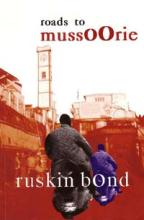
By now we were in Delhi, and when in the Central Cottage Industries Emporium on Jarpath Radial near Connaught Place I saw books by Ruskin Bond, a sometime contributor to a magazine I once edited, of course I bought one – an interesting experience in itself, as the process was broken down into its parts: agreement to the purchase and receipt of a docket at the counter; payment and having the docket stamped at a cashier two floors down; receipt of the book and surrender of the docket just inside the exit door.
The book is a collection of rambling essays about the joys of living in Mussoorie, a hill station in Uttar Pradesh. It turned out I’d read a number of the pieces before when RB submitted them as typescripts to the magazine (corrected with white-out and ink – I can verify his assertion in the book that he doesn’t use a computer). We published at least one of them. But there was a special pleasure in reading them so close to the place where they were written, and where Ruskin still lives, as far as I know. Among many delights, one that stands out is the little excursion into the history of potato in India – we had an Irish soldier to thank for the plentiful potato that seemed to feature in every meal.
The Henning Mankell book made the cut because both Penny and I have enjoyed his detective stories, and I’m respectful of his two books for young people (one of which deals, like this book, with AIDS). Written, according to an endnote, in fury at the role of the West in relation to AIDS in Africa, it appears to have been revised in haste, to have done without beta readers altogether, and been copy-edited on a tight budget. The result is that, though the same endnote asks that the book be taken seriously as shedding light on terrible things, it actually comes across as a clumsy fantasy of wickedness, a rickety, even incoherent, echo of Le Carre’s The Constant Gardener, a trivialising of the issues about which Mankell undoubtedly cares deeply. The translation may be partly to blame, but I don’t think so.
We didn’t have the heart to inflict this on any of our fellow travellers, so it found a bin in the pink city of Jaipur.
We brought The One from the Other for pretty much the same reasons as the Henning Mankell, except I haven’t read any of Philip Kerr’s children’s books. It ranked low on the relevance scale, though as I took my malaria tablets one morning, I enjoyed the moment’s connection to the book’s maguffin, a cure for malaria which was to be found at monstrous cost.
It turns out to be a ripping good yarn, in an amusing tough-guy voice; its incidents and conspiracy theories are plausible; and its endnote provides quite a bit of information on the sources on post-war Germany and Austria where it is set. Of course, Kerr has the advantage over Mankell of a setting nearly 60 years in the past, which is well documented and much storied, and in which he has already set a number of novels. Still … we didn’t have any qualms about passing this one on.
Michelle De Kretser writes a pretty damn good sentence, and a pretty damn good yarn. Our copy of The Hamilton Case is a hardcover, so not designed for ease of packing, and neither Penny nor I had read anything by this author. We must have thought its setting made it relevant. And indeed, Ceylonese complexities did resonate with our experiences in the land of the former British Raj. The resonances weren’t always comfortable. I noted down a couple of neat observations:
There is an old instinct, at work in bordellos and the relations of East and West, to convert the unbearable into the picturesque. It enables a sordid existence to be endured, on one side, and witnessed, on the other, with something like equanimity
and
The coloniser returns as a tourist, you see. And he is mad for difference. That is the luxury commodity we now supply, as we once kept him in cinnamon and sapphires.
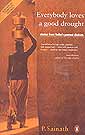
On the train from Delhi to Agra we got chatting with an Indian couple from Pune who were also sightseeing. In a wide-ranging conversation, I asked if they would recommend any books about India by Indians. They mentioned Everybody Loves a Good Drought. The first time I got to a bookshop was in Pushkar in the last couple of days of our trip, and sure enough, there it was, along with just about every other book by an Indian or about india that I have ever read. I read it on the plane home, and haven’t quite finished it. The subtitle says it all: ‘Stories from India’s Poorest Districts’.
It’s wonderful, powerful journalism: P Sainath spent some years travelling around talking to the poorest of the poor and writing articles for The Times of India. This is a collection of the articles linked by short generalising essays. It gives faces and voices to the poor, and it’s unremitting. Nothing picturesque or ‘different’ here.
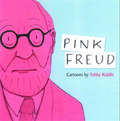
Tohby’s collection of cartoons from the weekend magazines of the Sydney Morning Herald and the Melbourne Age was on the hall table on our return, a very welcome gift. I was still making frequent visits to the toilet, and this book made the experience much less unpleasant. I include it here, because it was part of the India experience to come home to something so very Sydney: warm, witty, elliptic, muted, spiritual and sometimes laugh-out-loud. I particularly liked the image of a search and rescue worker who, when asked where he’s going, says, ‘I’m going to India to find myself.’
Teresa Nielsen Hayden is a finder of wonderful things, many of which she puts in the Particles sidebar on Making Light. She posted a link to this page, which lists common errors in English, possibly as many as 2008 of them. As I grow older and either mellower or more easily confused, I increasingly need this kind of thing. I looked for two words that have been giving me gip recently: reticent and obtuse. I’m pleased to report that the list confirms in each case my sense that these words are slipping badly in common journalistic usage:
‘Reticent’ most often means ‘reluctant to speak’. It can also mean ‘reserved’, ‘restrained’, though conservatives prefer to use it to apply only to speech. If you’re feeling nervous about doing something, you’re hesitant: ‘I’m hesitant about trying to ride a unicycle in public.’ ‘Hesitant’ is by far the more common word; so if you hesitate to choose between the two, go with ‘hesitant’.
and:
Most people first encounter ‘obtuse’ in geometry class, where it labels an angle of more than 90 degrees. Imagine what sort of blunt arrowhead that kind of angle would make and you will understand why it also has a figurative meaning of ‘dull, stupid’. But people often mix the word up with ‘abstruse’, which means ‘difficult to understand.’ When you mean to criticise something for being needlessly complex or baffling, the word you need is not ‘obtuse’, but ‘abstruse’.
The author of the list, Paul Brians, also gets points from me for his judicious remarks about ‘they’ and ‘their’ as singular pronouns.
[This post, transferred from my original blog, Family Life, which is no longer accessible, is even more to the point now than it was in October 2007.]
Via Making Light’s Particles, I draw your attention to the Unitarian Jihad, as reported by Jon Carroll of the San Francisco Chronicle. (If you don’t know any Unitarians, you should. Someone – it might have been Erasmus Darwin – described Unitarianism as a mattress to catch a falling Protestant.)
Beware! Unless you people shut up and begin acting like grown-ups with brains enough to understand the difference between political belief and personal faith, the Unitarian Jihad will begin a series of terrorist-like actions. We will take over television studios, kidnap so-called commentators and broadcast calm, well-reasoned discussions of the issues of the day. We will not try for ‘balance’ by hiring fruitcakes; we will try for balance by hiring non-ideologues who have carefully thought through the issues.
We are Unitarian Jihad. We will appear in public places and require people to shake hands with each other.
Read the whole thing. It’s funny, and a dream of a much better world.





 It’s been a while since I’ve posted anything about our block’s long, slow journey towards once again having a functioning corner store. There have been signs of progress lately. The windows have been replaced, or at least had their woodwork scraped back and varnished, and noises and lights have been reported at odd times of the day and night, mostly on weekends. Sadly, before I could have a stickybeak and maybe take a photo of developments, all the windows had white paper sticky-taped to their insides, so developments have been shrouded in mystery … until today, when a news bulletin appeared on one of the papered windows: