John Upton’s Embracing the Razor

John Upton, Embracing the Razor (Puncher & Wattmann 2015)
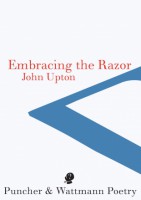
Embracing_The_Razor

A long-ago episode of the TV soap Neighbours featured two much-loved little dogs, named something like Stella and Pooch. When one of the dogs escaped to the dangerous street, the distraught dog-minder ran out his front door and fell to his knees in his driveway. As the camera pulled back and up he put his hands to the side of his head and cried out in Brando-esque anguish, ‘Stellaaaa!’  (Just in case a reader needs it, here’s a link to the cinematic moment being parodied.)

John Upton wrote a more than 130 episodes of Neighbours between 1985 and 2006, and I like to think he was the one who poked that hole in the soap wall for a silly shining moment (Added years later: I was wrong. That episode was written by Megan Herbert). He’s written a lot else, for television and the stage, but this is his first book of poetry.

The book is in four sections: ‘Grief’, a narrative sequence about death and bereavement, which the back cover tells us is on the death of Upton’s wife; ‘Embracing the Razor’, which is largely about the ills of old age – including various kinds of surgery, Alzheimer’s, bereavement; ‘Destinations’, fourteen poems of travel; and ‘Rhymes and Rhizomes’, a miscellany.

It’s the first section that has drawn me back for several readings. Even without the back cover note, it’s clear that these eleven poems are rooted in direct experience; and the discipline of decades of crafting story for TV means the character development and narrative elements are confidently, effortlessly there, allowing the poetry to do its work. A hospital car park as ‘a desert of panic nosed / into dutiful bays’. And how’s this for capturing the feel of visiting a hospital:

At the lift, two people. Polite smiles. 'It takes a while,'
he says. I offer, 'Yes.' In this desperate place
somehow we need to touch.
'It's on the seventh,' she adds, feeling foolish.
They don't seem to be together.
We watch the numbered light ascending.
Like a saint, I think. I'm not religious.
'The other one's coming down,' he mutters. Steel jaws
wide enough to gulp a bed and nurses
creep open horizontally. I press Intensive Care.
They don't say anything.

The book is full of neat similes and deft observations of this sort, but, especially in the first sequence, they serve a deeper purpose – the poems tell of grief, but to use Emily Dickinson’s phrase, they tell it slant, in verse that is marvellously disciplined, courteously aware of the reader. One poem begins, ‘Cat shit in the bath again,’  another deals with lost paperwork for the memorial garden. Even the moment of death is relayed, in ‘Morphine Around Midnight’ with extraordinary restraint:

I ask the nurse,
'How long?' 'Not long.'
One hour, five minutes.

A decade ago, we thought my partner – known in these pages as the Art Student – was dying of advanced pancreatic cancer. It turned out that she had had an extraordinarily improbable series of false positives, and abdominal surgery revealed perfectly healthy internal organs. But we had a couple of intense weeks facing the prospect of imminent death. The early part of this sequence comes the closest of anything I’ve read to capturing the feel of that experience. I’m sorry John Upton had to go ahead and write the rest, but I’m in awe that he did it so well.

My copy of Embracing the Razor is a kind gift from Puncher and Wattmann.
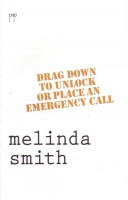
Melinda Smith’s Drag down to unlock or place an emergency call

Melinda Smith, Drag down to unlock or place an emergency call (Pitt Street Poets 2014)

melinda-smithThe most striking feature of this poetry collection is its wild variation in tone.

Take the ten poems in the book’s first section, ‘Uploads’. First comes ‘Passengers are reminded‘ (this and other links are to the poems on the poet’s website, Melinda Smith’s Mull and Fiddle): the speaker, on the way to a funeral, is held up by a delayed train, and her emotional state is evoked obliquely but powerfully. This is followed by a number of direct evocations of grief and loss, though the milieu becomes more literary (one poem is an address to Janet Frame) and the verse more formal (a fine villanelle, ‘Roadside Memorials‘, a pantoum and two syllable-counting haiku). Then the subject switches to divorce, and  the the tone changes abruptly: ‘Decree Nisi’ is pure verbal display, comprising 30 anagrams of its title, and the section’s final poem, ‘bittertweet’, is a cleverly vindictive, multilayered tweet-joke. It feels as if a rug has been pulled out from under the reader. But each poem in the section works in its own right, so all is well.

In the second section, it feels as if war has broken out. There are a number of powerful poems about pregnancy, miscarriage, labour, birth, postnatal depression, motherhood. Take this, from ‘Woman’s Work’:

A new body heaves from her into the light.
Exhaustion melts her. The women pass her the child;
the singers chant again:
Praise her, she has endured the great trial and renewed the life of the world.

Or take ‘Given‘, a response to Francis Webb’s great ‘Five Days Old’. Without detracting from Webb’s wonder as the miracle of a baby is given into his hands, it reminds us of the woman’s experience that has produced and sustains the miracle. ‘Untitled’, addressed to a baby lost at 11 weeks of pregnancy, tears at the heart.

Then – wham! – there are poems that mock or belittle those huge emotions. ‘A birth’, for example, ends, ‘Serenity explodes. I need a beer.’ And  the jaunty ‘Song of the anti-depressant’ in this context reads as an enactment of the great Australian embarrassment that compulsively attacks any show of emotion with a joke.

The mood swings continue in the remaining three sections: ‘News’, ‘Sport’ and ‘Weather’, though the self-deprecatory comic comes more to the fore so that heartfelt love lyrics, serious reflections or, say, ‘Laura to Petrarch’ (in which the beloved writes back – and comes close to calling Petrarch a stalker), are undermined by generally unfunny comic pieces about infidelity, the internet, the weather, and especially an ‘eat drink and be merry’ response to climate change that left a very sour taste in this reader’s mouth.

This book won the Prime Minister’s Literary Award for poetry last year, not one of the controversial winners. I bought my copy on the strength of the award, but while I’m confident it would be a pleasure to attend a poetry reading that included Melinda Smith, I won’t be rushing out to buy the next book given a gong by that set of judges.

aww-badge-2015

This is the fifth book I’ve read for the Australian Women Writers Challenge for 2015.

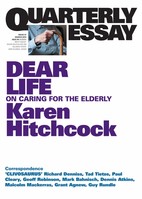
Quarterly Essay 57: Dear Life

Karen Hitchcock, Quarterly Essay 57: Dear Life: On Caring for the Elderly (Black Inc February 2015)

qe57

Like every Quarterly Essay, this one includes lively correspondence on the previous one. Guy Rundle’s Clivosaurus drew thoughtful responses from a number of writers of the left, defensive missives from representatives of The Australian, fascinating psephology from Malcolm Mackerras, and more. Much of it was too technical for my pay grade, but one thing is clear to me: if you get into an argument with Guy Rundle, it would be unwise to let him have the last word – he’s very good at the devastating rebuttal.

A number of people have already tweeted that every Australian should read Karen Hitchcock’s essay on the treatment of elderly people in our health system. She is a general physician who has worked in large hospitals in several Australian states, and so has extensive hands-on experience in working with frail and/or demented elderly people. As she says:

There are two strong narratives in our culture about the ageing population and death. The first is that medicine is keeping elderly patients alive against their will – medicine is denying a death the patient desires. The second is that elderly patients are seeking to stay alive unreasonably – the patient (or their family) is denying an unavoidable death.

The essay takes these narratives on fiercely, and does a brilliant job of unpicking the ageist assumptions and fanciful versions of sickness and hospitals on which they are built. She marshals her own personal and professional experience as well as current research to mount a convincing counter-narrative.

She describes the way modern medicine is fragmented into specialities, a situation that makes it hard to treat elderly people with multiple conditions.

She explores the concept of futility: is treatment futile if it extends a person’s life for just a few days but those few days allow them to say goodbye to family? can a hospital specialist who is as drenched in ageism as the rest of us and has no personal knowledge of a patient be trusted to make a sound judgement about the futility or otherwise of treatment?

She savagely rips into the often heard argument that the increasingly aged population will make the health care system unsustainable.  ‘Sustainable’, she argues, ‘is just a word for “what we are willing to pay”.’ And the real challenge to the health system comes not from the aged but from ‘a population of increasingly poor, obese, diabetic, sedentary young and middle-aged who are the multi-morbid patients of the future and who will require many drugs, doctors, operations (joint replacements, bariatic surgery, amputations, coronary vessel interventions) and hospitalisations’.

Advanced medical directives, documents that spell out ahead of time conditions that are not to be treated if a person is incapable of making their wishes known, are singled out for special opprobrium. Hitchcock is an excellent storyteller, and her story of 84-year-old Fred who came to hospital begging to be allowed to die is enough to win her case without any further discussion: he was wretched, and didn’t want to be a burden (an often heard internalised version of the message with which older people are too often bombarded); she listened to him, encouraged him, treated him, and followed up some time after he was discharged:

I said, ‘Fred , you told me you didn’t ever want to come back to hospital.’
He said, ‘Of course I want to come back if I get sick. I get silly when I’m sick. I hate everything. I say silly things.’

Not all her stories have such cheerful endings. Death does happen. But if we are to have a national electronic system where people’s advanced care directives are recorded, then these directives, she argues, should be reviewed regularly, even monthly, by the people whose lives they concern.

The essay discusses the isolation that is the lot of many elderly people, including those who are placed in nursing homes when their families can no longer care for them. It argues that this is an issue that should be taken up by the society as a whole – ‘if we are to attend to the social needs of our elderly citizens both inside and out of institutions, then we need government interventions and funding, along with the community’s engagement and help.’ What is needed, and what is beginning to happen in some places is

a shift in perspective: the elderly are not a growing cost to be managed or a burden to be shifted or a horror to be hidden away, but people whose needs require us to change our society. They are those for whom we are responsible and to whom we owe real care.

Another sacred cow the essay takes head-on is the idea that it is better to die at home than in hospital. My own father had himself discharged from hospital in Townsville when he knew he was dying, and was flown and driven the 500 miles to Innisfail because he wanted to die at home. I have no doubt that that was a good decision: he spent his last days surrounded by friends and family, being visited by a doctor he’d known most of his life and a nurse he’d known all hers. He died in bed beside my mother, his wife of more than 50 years. But Hitchcock makes it very clear that his situation was exceptional in the western world today. A hospital death can be a good death.

In short, this Quarterly Essay is a call to arms against the oppressive attitudes and practices which we have insinuated their way into our minds and practices around older people. I’m 68, not yet in the frail and/or demented group that Hitchcock is talking about. I hope I never will be. But reading her essay, I wonder if my GP’s slightly disturbing lack of interest in my symptoms on my most recent visit, which I put down to his having had a long day or perhaps the lack of drama in my presentation, might have grown from an assumption that once you’re past a certain age you just have to put up with a certain amount of suffering. And that’s partly Karen Hitchcock’s point: if the problems she writes about are chickens, then we are all roosts waiting to happen.

aww-badge-2015

This is the fourth book I’ve read for the Australian Women Writers Challenge for 2015.

Tim Winton’s That Eye, the Sky at the Book Group

Tim Winton, That Eye, the Sky (McPhee Gribble 1986)

1TETSBefore the Meeting: That Eye, the Sky isn’t an obvious choice to discuss at a book club close to 30 years after it was published. It’s even less obvious, given that one or two of our members have disparaged Winton’s work (apart from Cloudstreet) fairly comprehensively. But we were looking for a film–book pairing and a couple of us – at least, I hope it wasn’t only me – remembered being moved by John Ruane’s movie based on this book. And it’s short.
I have mixed feelings about Tim Winton’s work. I loved The Turning, felt that the slow bits of Dirt Country were adequately compensated by other elements, especially the ending, and found The Riders close to pointless. His chapter in Big Surf, last year’s  essay on class  and his Palm Sunday oration about asylum seeker policy are all marvellous. Generally, I love his sentences. So, though I had loved the film (apart from a dimly remembered unease about the Peter Coyote character), I approached That Eye, the Sky with cautious optimism.

The narrator, Ort (short for Morton), is the 12 year old son of ex-hippies, living poor on the outskirts of a Western Australian city. His father has a car accident which leaves him in a coma then pretty much vegetative until the very last pages. Henry Warburton, a man Ort and his angry older sister Tegwyn have seen living rough under a nearby bridge, turns up and helps the family, bathing the incapacitated father and doing odd jobs. Henry, it turns out, is a bit of a loose cannon, but before his looseness becomes completely apparent he converts Ort and his mother to his peculiar brand of Christianity. Meanwhile, Ort is the only one who sees a strange light that hovers over their little house – possibly an after-effect of Ort having been comatose and died, twice, when he was little and had meningitis; or possibly Ort’s contact with a reality beyond this one.

The complex web of relationships is beautifully done, including Ort’s belligerent friendship with the boy from across the road, but I wasn’t convinced by the magic realism, if that’s what it is, and there were whole swathes where it felt awfully as if Tim Winton was wanting to tell us about the Bible. I was reminded of what someone said about Rob Reiner’s movie Stand by Me: there’s a lot of swearing and other stuff that lets the movie get away with its moments of tenderness. Well, Ort’s matter-of-fact description of bodily functions, and the final revelation of Henry’s moral dubiousness aren’t enough for this book to get away with its spiritual message. Not that there’s anything wrong with non-institutional Christianity – I just don’t believe in it in this book. The device of the uncomprehending child narrator – ‘What Ort Knew’ if you like – becomes annoying as one feels the ventriloquist author behind him:

The forest moves quiet tonight. Jarrahs move a long way up and out of sight. Now and then I hear little animal noises. All these trees are dying, and all these little animals will have nowhere to live. One day the whole world will die and we’ll die too. My back hurts and my bum stings and the backs of my legs too. I’ve got no clothes on out here in the forest. Prickles and burrs and twigs stick in me all over. I rub them in, squirm and shake around. It hurts a lot. I’m hurting myself. I want to hurt myself. I want to.

It made me yearn for the easy flow of Winton’s own unmediated prose.

The meeting: We couldn’t find a copy of the film anywhere. So what we had was dinner, each other and the book!

(That much was uploaded prematurely. Here’s a bit more about the meeting.) Perhaps because two of the six of us arrived late, the discussion of the book kept up for most of the evening. Each new arrival would be asked for an opinion and that opinion would set us all off again.

My impression is that we were all uneasy about the book’s supernatural/ religious/ spiritual elements , which just weren’t integrated into the story. On the other hand, when I singled out as implausible the passage where Ort summarises the Bible, someone said that a childhood friend of his had told him about this fantastic story of a bloke who gets nailed to a tree. So not so implausible.

Interestingly enough, the book triggered a spate of reminiscences: of country childhoods, of vengeful boyhood impulses involving urination, of helplessly witnessing someone’s life spiralling towards disaster.

As someone said, irritating but compelling.

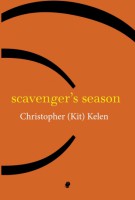
Kit Kelen’s Scavenger’s Season

Christopher (Kit) Kelen, Scavenger’s Season; Fragments of an almanac  (Puncher and Wattmann 2014)

scavengers_season

Kit Kelen mostly lives in Macau, but there’s a patch of bush in New South Wales where he has spent a lot of time over the last quarter century. The 150 pages of Scavenger’s Season are filled with poetry of that place – as the title page says, they are ‘poems at Markwell, via Bulahdelah to mark the quarter century’. We’re invited to immerse ourselves in the poetry as Kelen immerses himself in his bit of bush.

Drought, rain, fire, the sounds of the bush at night, bush regeneration, the passing of the seasons, white and black cockatoos, wild and domestic animals, pastoral lyric, blokes and sheds, and through it all the experience of being humble with the bush. I just loved this book. I’ve read most of it a number of times. Some of the poetry is difficult to decipher, and I just plain gave up on two long poems, but mostly the difficulty is of a kind that offers new rewards every time you go back to the poem.

Kelen’s relationship with his patch of land is a kind of groping opposite to the colonising farmer attitude so elegantly articulated in David Campbell’s ‘Cocky’s Calendar’: ‘The hawk, the hill, the loping hare, / The blue tree and the blue air, / O all the coloured world I see / And walk upon are made by me.’ The ‘me’ who makes that world does it as farmer, but also as poet. Kelen echoes this idea  uneasily in ‘minor manifesto’:

one should acknowledge mastery

among sunfall and foliage
loathed and admired
is it not I who make
the landscape looking?

But there’s no hint of Campbell’s triumphalism. It’s a question, and the next lines suggest that the answer is complex:

I am the field here
cattle numb in
rain is waiting
for thirst to be spoke
taps on my shoulder home

That might be hard to follow if you haven’t acclimatised to Kelen’s language (more about that later), but I read it as continuing the acknowledgement of ‘mastery’, but modifying it – he doesn’t just make the field for cattle to be numb in (I don’t think he likes cows much), he is the field; and in the last three lines the ‘mastery’ becomes very tenuous – thirst may give rain meaning, and rain when it comes may serve the speaker’s purpose, but rain exists independently of how we need it, understand it or welcome it.

These line’s from the title poem, ‘Scavenger Season’, are more characteristic of Kelen’s attitude:

it’s true that I make no use of the land
that the land has no use for me

if each has a voice and neither has spoken
then there might be a treaty yet

‘little manifesto’ , which I quoted from above, is one of a dozen long poems in the book – it runs to eight pages. In a moment that’s characteristic of the book’s understated humour, the poem ‘manifesto’, not a little one this time, consists of just four lines:

from my door

everywhere leads me
every way home
nowhere but the way

I want to say a little bit about the language of the poems.

From my brief time as a 19 year old schoolteacher, I  remember only one piece of student writing. It’s a sentence in an essay written by a boy in Year 8, describing his arrival home from school: ‘Dog barking and jumping and licking my face.’ I knew that this was not a proper sentence, and it was my job to correct it. I did so, but with a heavy heart because I knew that pushing the sentence into a ‘proper’ shape (‘The dog barked and jumped up and licked my face’) would rob it of vitality and only theoretically make it clearer. My student had recently arrived from somewhere in China, so I guessed that his syntax wasn’t so much mistaken as transplanted. And technically incorrect as his sentence may have been, I remember it 50 years later.

Towards the end of my second reading of in Scavenger’s Season I realised that something similar was happening. The opening lines of the first poem, ‘think of this’, are as good an example as any:

think of this
a string of pearls
trail of droppings
as you’re disposed
or as light catches

The paraphrasable meaning is clear enough, but something odd is going on. It’s as if some words have been erased: ‘Think of this [as] a string of pearls [or as a] trail of droppings, as you’re disposed  [to] or as [the] light catches [them.]’ Almost every poem in this book asks for that kind of work from the reader.

Filling in the elisions isn’t always as simple in those five lines. The very next lines are pretty opaque:

think this where you’ve always been
and this advice could not have sought you
these your ageless friends among

But mostly the words cohere in response to slow, open-minded and open-hearted reading. It’s not unpleasant: it’s a little like reading in a language one learned long ago and has a rusty hold of – there’s a deep pleasure in feeling meaning emerge. I think that Kelen, who has taught at the University of Macau for 14 years, is doing what my Year 8 student did: writing English that is influenced by Chinese syntax. The result is richly memorable.

So there you have it: a book that invites you to join the poet in an immersive experience of the Australian bush, flavoured by a deep familiarity with Chinese culture and language.

I received a complimentary copy of this book from the publishers. I’ve read and re-read, used and abused it so much I may have to buy a fresh one with my own money!

MOST mattress

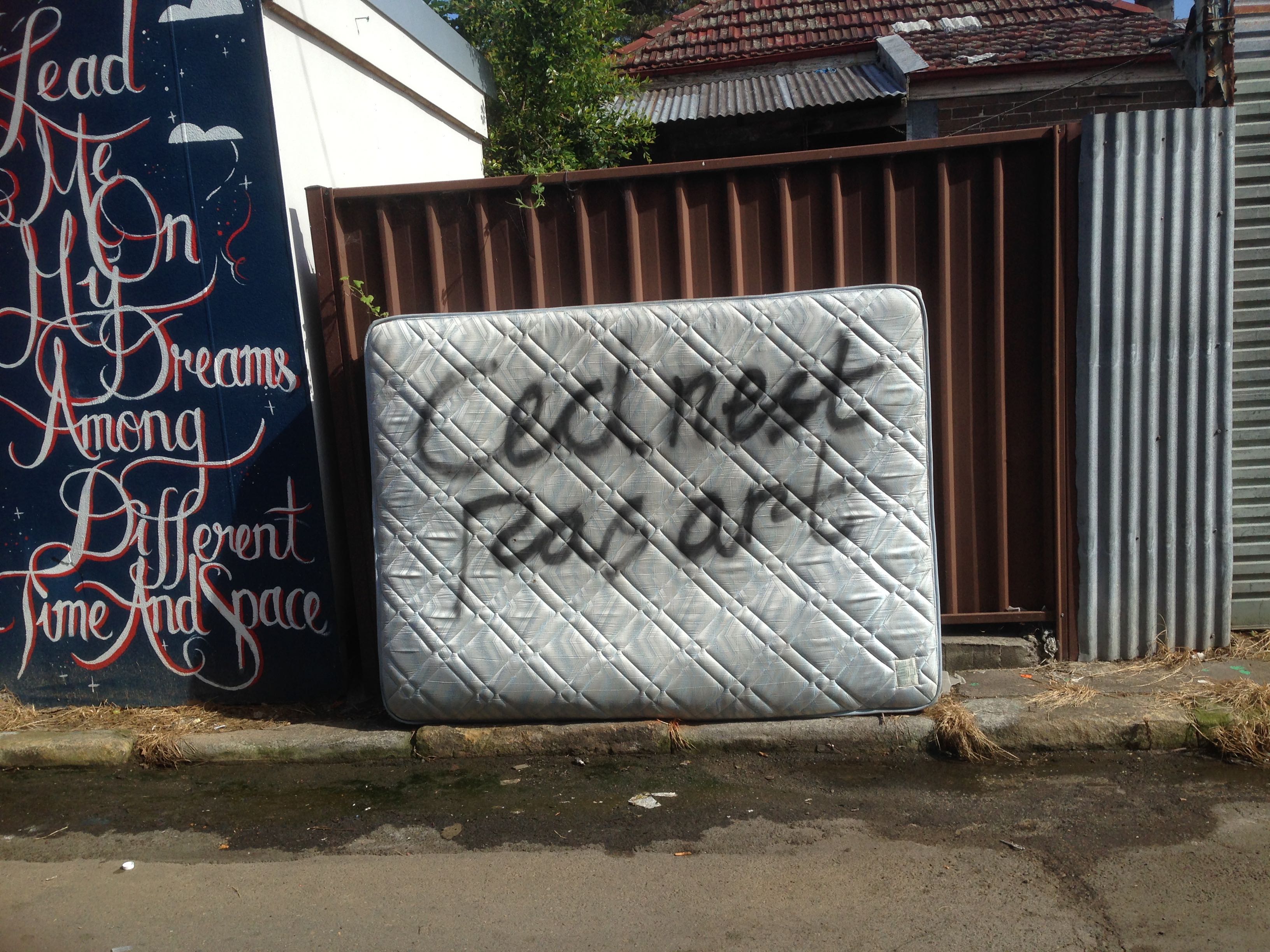
The Marrickville Mattress Poet put in an appearance as part of the Marrickville Open Studio Trail on the weekend. This homage to Magritte was part of the Fairy Alley exhibition.

Mattress

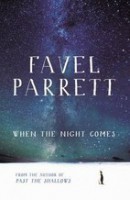
Favel Parrett’s When the Night Comes

Favel Parrett, When the Night Comes (Hachette Australia 2014)

wncFavel Parrett’s first novel, Past the Shallows, published in 2011, was a hard act to follow. In When the Night Comes, her second, she moves to a bigger world, out past Tasmanian waters to Antarctica and Scandinavia, and into a delicate, tender relationship between an adult man and a girl just entering her teens.

I’m tempted to say that it’s actually two novels.

First there’s the one described in the author’s endnote. This is a celebration of the Norwegian ship, Nella Dan, a real ship whose history is sketched in the note, along with affectionate quotes from a number of people who sailed in ‘the little red ship’. If such a celebration had been written by, say, Neal Stephenson, it might have included bravura passages dramatising the ship’s inner workings – the heat and noise of the engine room, the pinging wheelhouse, the compartmentalisation of the hull. But this is not that kind of celebration. Here the engine is background noise that helps the sailors sleep; we spend time in the ship’s kitchen, but no ink is spilled on describing the stoves; if the size of the crew may be mentioned I don’t remember it. In fact, apart from its bright red paint and its size – sometimes surprisingly small, sometimes surprisingly big – we don’t have much sense of the ship as a physical thing at all. What we do have is the way all the characters respond to it, to her, as a dependable almost-maternal, almost-comradely, presence. Almost those things, because Nella Dan never really emerges as a character in her own right.

The other novel is the one I read, and was moved by. In it, the Nella Dan is an interesting setting for part of human story. This story moves between two points of view. The first is that of Isla, 12 or 13 years old, who has recently moved to Hobart with her mother and her younger brother (never known as anything other than ‘my brother’) after their parents’ marriage break-up. A Danish sailor named Bo becomes a regular part of the family. As Isla is completely uninterested in the world of adult relationships, we pretty much have to deduce that Bo and Isla get to spend time together because Bo and Isla’s mother are having a fling, a romance, a domestic relationship of some sort.  Bo’s is the other point of view, and we travel with him on the Nella Dan into Antarctic waters.

Dramatic things do happen: each of the main characters has to deal with the violent accidental death of a close friend, for example, and the Nella Dan runs into the perils of the Southern Ocean. But the strength of the book lies in it depiction of the delicate connection between these two people that allows Isla to imagine herself in a much bigger world, and Bo to find sweet companionship. It feels easy, but when you consider we live in a climate where closeness between an adult male and a child not his own is often looked on with deep suspicion, I can only say I’m deeply impressed – and grateful – for what the book offers.

Sadly, my copy was on loan and has been reclaimed by its owner, so I can’t quote anything. Trust me. Favel Parrett writes lucid, supple prose. The book is full of pleasures.

aww-badge-2015This is the third book I’ve read for the Australian Women Writers Challenge for 2015.

Joe Sacco’s Bumf & Snyder and Murphy’s Wake

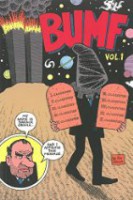
Joe Sacco, Bumf Vol. 1 (Fantagraphics 2014)
Scott Snyder & Sean Murphy, The Wake (Vertigo 2014)

1606997483I can think of three possible meanings for the title of this comic. In my youth, ‘bumf’ was short for ‘bumfluff’, the fine hair that grows on the faces of teenage boys. That meaning is irrelevant. More recently, ‘bumf’ has signified the kind of material that people put stickers on their letter-boxes in a futile attempt to stave it off. Given that Joe Sacco’s reputation rests on meticulous journalism, and this book is scurrilous, quasi-libellous satire, perhaps the title suggests that this book is filling in time until he gets back to his real work. If so it’s ironic, because this is as serious a piece of commentary as you’re ever likely to come across.
The third possible meaning is indicated by the book’s subtitle, ‘I Buggered the Kaiser’. But perhaps, given that Sacco writes US English, that meaning would require the form ‘buttf’. (For reasons I don’t understand, anal rape of adult males is fair game for US humorists and satirists, unlike just about any other class of sexual nastiness.)

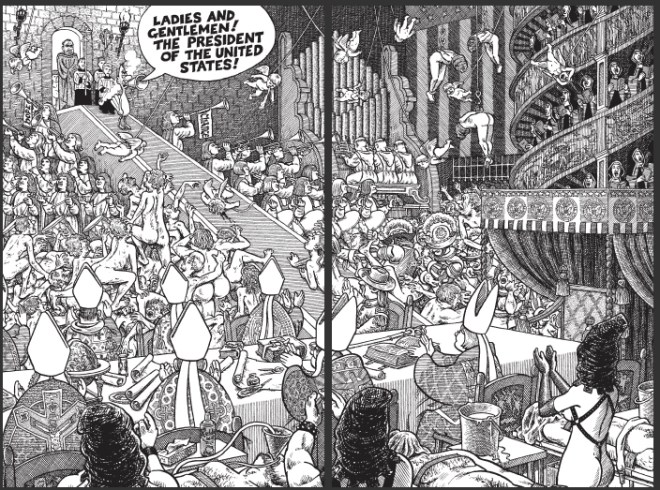
Anyhow, in Bumf Sacco casts aside his responsible-journalist persona and emerges as a satirist in the tradition of early Robert Crumb and pre-Maus Art Spiegelman. The front cover has an inset caricature of Richard Nixon, archetypal abuser of presidential authority, saying, ‘My name is Barack Obama … and I approve this message.’ Obama’s name is never mentioned again, but the main storyline – or one of them, the other one is the World War I epic referred to in the subtitle – features a resurrected Nixon who presides over the post-Abu Graibh, post-Snowden world of US surveillance, drones, rendition and torture machinery, and wonders, among other things, why there’s a beautiful Black woman in his bed.

There’s full frontal nudity on most pages, and quite a bit of it is en masse. And though the naked people tend to be plump and hedonistically involved, there’s something desperately pathetic about them – like the souls in Gustav Doré’s Inferno. 1sacco

You’ll notice that in the foreground of this grimly cheerful image there are scenes of sexualised torture. There’s a lot more of that. 

To extend the Dante comparison, Sacco puts himself in the frame – not as a privileged visitor like Dante, but as a graphic novelist who is complicit in the propaganda and violation of human rights that Nixon/Obama sanctions.

If you’ve seen Citizenfour, Laura Poitras’s chilling documentary about Edward Snowden, you won’t find it easy to dismiss the extremity of Bumf as pure fantasy. The Nº 1 in the title suggests that there is more to come.

1401245234One of my regular birthday joys is that I can expect comics as birthday presents from my sons. This year, I was given Bumf and The Wake.The latter came in a plastic wrapper, with stickers proclaiming it to be the winner of the 2014 Eisner Award for the Best Limited Series. That makes it an excellent birthday present even before the plastic has been broken.

Sadly, I can’t say I enjoyed it. It’s as dystopian as Bumf, and plays with our fears about climate change in powerful ways, involving giant tidal waves and huge monsters rising from the depths of the ocean. The plot, which involves a rewriting of human evolution, is bold, inventive, and well resolved. The images are powerful and dynamic. But I’m just not part of the target audience. Where Bumf is animated by rage at abuse of power, The Wake plays on despair and that form of human self-loathing that infects parts of the environmental movement. Completely understandable, but something that needs to be resisted rather than indulged.

Art theft in Enmore

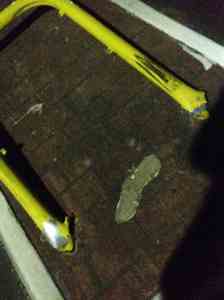
A little over a month ago, I noticed a suspicious looking object on the pedestrian island just out the front of our house. It looked like a discarded shoe, but not quite. On closer inspection it revealed itself to be a Will Coles sculpture.

IMG_1187In case you can’t quite read it, the text on the sole of this cement shoe is ‘forgotten’, making it an elegant addition to the scattering of cement objects in our suburbs reminding us of our fragility, and the fragility of our environment.

But ‘forgotten’ wasn’t meant to last. To tell the truth I’d forgotten all about it until a car collected the barriers on the island on the weekend. Only then did I notice that all that remained of the sculpture was a stark shoeprint:

shoeprintThe shoe was gone before the barrier was knocked down.The barrier will be replaced in a week or so. The sculpture is now a prized – and prised – possession of a private art collector.

Joshua Ferris’s To Rise Again at a Decent Hour

Joshua Ferris, To Rise Again at a Decent Hour (2014)

0141047380

If this hadn’t been shortlisted for the Man Booker Prize I wouldn’t have lasted more than 30 pages. The narrator is a dentist who has a gift for clever sounding banality. He goes on about US baseball teams, his dental hygienist’s Catholicism (he’s an atheist himself, of Protestant background), Jews (one of whom has described him as philosemitic), the internet and of course himself – his sorry history with women and, obliquely, his miserable childhood. When on page 96 he uses the phrase ‘the chronic affliction of my self-obsession’, I felt strongly that it was the readers who were afflicted. 

Take this, from page 120:

While standing in line to buy cigarettes …, I noticed a headline on the cover of a celebrity magazine. ‘Daughn and Taylor Back Together?’ it read on big print, and my mind returned to it later in the day while I worked on a patient. I didn’t know that Daughn and Taylor had gotten together, to mention nothing of them breaking up, and now, possibly getting back together again. More troubling still, I didn’t know who Daughn and Taylor were. Daughn and Taylor … I thought to myself. Daughn and Taylor … who are Daughn and Taylor? It was clear that I should know them, given the significant real estate their debatable reconciliation had commanded on the cover of one of the more reputable celebrity magazines. But I didn’t know them, and not knowing them, I realised I was once again out of touch. I would be in touch for a while, and then a headline like ‘Daughn and Taylor Back Together Again?’ would come along to let me know that I was out of touch again.

And he ruminates for another page and a half until he finally asks his office manager/ex-wife who Daughn and Taylor are.

Some readers might be riveted. The plot, to that point, is very slight. Someone has set up a web site in his name advertising his practice, and there is an odd quote that could be from the Bible in his website bio.

I told myself that if the Man Booker judges liked the book enough to prefer it to Siri Hustvedt’s The Blazing World, then something interesting must be lurking over the page. I read on.

The second half of the book is much more interesting than the first. It turns into a kind of Da Vinci Code or Foucault’s Pendulum, only written in decent prose and without exhausting historical research. It explores similar territory to  Howard Jacobson’s The Finkler Question, with added fantasy. It even becomes fun. As a non US-er, I’m glad to have known a Red Sox fan and witnessed her joy when they won a 2004 baseball competition – it turns out that the narrator’s regular rants about the Red  Sox have an excellent pay-off (as the many rants like the one about Daughn and Co don’t – they just don’t).

So my recommendation, in short: speed read the first five chapters (as literary judges, being busy people, may well have done) and you might end up loving this book.