Judith Beveridge, Wolf Notes (Giramondo 2007, 2010)
On a Sydney Writers’ Festival panel some years ago Inga Clendinnen indulged in a flight of metaphor, saying that the writer of a personal essay takes the reader by the hand and says, ‘Come walk with me,’ while a novelist invites a reader to play Catch-me-if-you-can. The novelist who chaired the panel commented afterwards that though he adores Inga (as who doesn’t?), he was a little offended. At the risk of offending poets everywhere then, I’d like to suggest that the author of a book of poems is saying, ‘Come in, make yourself at home, stay a while.’
That is to say, I have to live with a book of poetry for a while before I feel that I’ve actually read it. At this stage of my relationship with Wolf Notes, I can say confidently that there’s lots of good stuff in it, but I’d have read it again, dip into it, and do some digging before I could say anything useful about it. (I’ve just read Martin Duwell’s latest entry on his Australian Poetry Review site, and I tell you I’m in awe.)
For an example of why I’m not competent to say much about this book, I have no idea why the first of its three parts is called ‘Peregrine’: it begins with character sketches of people you might see in an Asian city or countryside – a saffron picker, a pedlar, a bone artisan –, and goes on to a miscellany of other subjects – a contemplative walk beside a lake, a suicide, a boy killed by leeches, a mother wrestling with inexplicable sadness, a crew of three on a fishing boat, and so on. Does the title suggest that the poet is a pilgrim? A falcon? I draw a blank.
In a different way, it seems that to appreciate the middle section, ‘Between the Palace and the Bodhi Tree’, described in an introductory note as ‘an imaginative depiction of the time Siddhattha spent wandering in the forests and towns before achieving enlightenment’, I would have to learn something about Buddhism and the story of the Buddha. I found many of these poems beautiful, especially the ones filled with observations of the natural world, but I have very little clue where they stand in relation to Buddhism: are they devout meditations or relatively unengaged textual games? I think the former, but don’t know enough to be sure. (The third section, ‘Signatures’, presents no general problem – it’s a number of monologues, easily understood to be their speakers’ signatures.)
So far I’m just a visitor to this book, then, but it offers enough observation, drama, wit and seriousness to make me want to spend more time here. One pleasurable thing is the way the moon appears again and again, especially in the middle section. If I quote a number of its appearances, you’ll get some idea of Judith Beveridge’s voice, at least when she’s channelling Siddhattha:
From ‘The Rains’:
————— I look at the moon
primed and narrow as the sting
of a scorpion’s tail.
From ‘Quarry’:
I watched the moon gather shine
like limestone in a mason’s hands.
From ‘Circles’, after describing vultures in picking at a dead ox:
I saw the moon, a desecrated bone
upon which those birds
might drip some blood.
From ‘New Season’:
——————————— the sky’s
depth, where the moon pares itself down
into the smile of an obedient wife
From ‘The Krait’:
I was scared. I didn’t notice the moon,
a fang poised above my slightest act.
From ‘Doubt’:
Today I hear only wind smuggled in.
The moon bears down with its gift-less smile.
From ‘Death‘ (possibly the most immediately accessible poem in the book, it’s the fourth or fifth one down at that link):
Even the moon can’t keep itself clean:
soap soiled by a dung-collector’s hands.
From ‘Ficus Religiosa’:
I vow with all beings
to sit until the moon, a bowl,
is almed only by the Good.
Same moon, same poet, different poems, different feel. I won’t be shaking this book’s dust from the soles of my sandals for a while yet.
It’s tempting to say that Audrey Niffenegger creates comics for people who don’t like comics. It’s probably more accurate to say that she creates the kind of comics that appeal to people who like, say, Emma Magenta’s work, or Kate Williamson’s, which are, after all, comics as much as Watchmen or Sin City. (I’ve read both Emma Magenta and Kate Williamson thanks to the Book Club, which is also where I got The Night Bookmobile.)
The Night Bookmobile is more like other comics than The Three Incestuous Sisters, the only other of Niffenegger’s books I’ve read, in which the text played very poor second fiddle to the images. This is much more integrated. A young woman called Alexandra (get it?) discovers a fantastical night bookmobile that contains every book she has ever read. Over the years she encounters the bookmobile and its kindly, melancholy driver a few more times, and each time its collection has grown to incorporate what she has read in the meantime. It’s like a dream incarnation of a LibraryThing account. Alexandra becomes a librarian and longs to work in the bookmobile. Two pages of skippable text at the end explain how to interpret the story, and tell us that its the first instalment of a much larger work, The Library.
I was charmed, and not just charmed, but unsettled by the book’s dark and mercifully unexplained elements. There’s something half in love with death about Niffenegger.
As it happens, Perry Middlemiss’s site, Rhymes Rudely Strung, which publishes an Australian poem a day, turned up today with this, first published in The Bulletin in 1917, but taking Niffenegger’s sex-death-books connection and running with it:
Books
by Zora Cross
Oh bury me in books when I am dead,
Fair quarto leaves of ivory and gold,
And silk octavos bound in brown and red,
That tales of love and chivalry unfold.
Heap me in volumes of fine vellum wrought,
Creamed with the close content of silent speech.
Wrap me in sapphire tapestries of thought
From some old epic out of common reach.
I would my shroud were verse-embroidered too –
Your verse for preference, in starry stitch,
And powdered o’er with rhymes that poets woo,
Breathing dream-lyrics in moon-measures rich.
Night holds me with a horror of the grave
That knows not poetry, nor song, nor you;
Nor leaves of love that down the ages wave
Romance and fire in burnished cloths of blue.
Oh bury me in books, and I’ll not mind
The cold, slow worms that coil around my head;
Since my lone soul may turn the page and find
The lines you wrote to me, when I am dead.
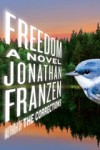
There’s no doubt this is a terrific book. It tells the story of one US family through the Bush–Clinton–Bush–Obama years, taking in the bigger picture (the Iraq invasion, environmental despoliation, global warming, technological change …), while giving us sharply realised characters whose lives illuminate the times without ever feeling as if they’re determined by the author’s agenda. The words free, freedom, liberty and so on ring like chimes through the pages suggesting without being glib that a freedom that involves loss of connection – to other people, to the natural world, to one’s own best self – is not worth having. I love the way characters are astonished to find themselves reproducing patterns of behaviour they have hated in their parents, and the way character after character struggles for integrity in a deeply compromised and compromising society. A sequence in the last seven pages touched some deep place in me that made the whole book sing.
But I was a resistant reader until those last pages. Partly this was a matter of timing – two things had set me up to fight the book every inch of the way.
First: I began reading it with those shocking VIDA pie charts about gender and literary publishing fresh in my mind, knowing that Freedom had been published amid a hype-storm unthinkable for a grown up novel written by a woman. As a result the book had an invisible frame around it announcing it as a privileged book by a privileged author about privileged characters, to read which was an endorsement of white English-speaking middle-class male privilege. This frame was gilded by the experience of reading in public. I regularly read while walking, while waiting in queues, on the bus, a practice that occasionally provokes comment, but only with this book have perfect strangers asked me how I’m enjoying it, and then say what they’ve heard – this happened twice.
The whole book can be read as a criticism of that very privilege, though I only noticed the word once. After I had written the first draught of the previous paragraph I encountered the only non-White characters in the book (apart from a beautiful and talented young woman of Indian heritage, who does have a major role), in this sentence, at a funeral towards the end:
It was only when the service finished that Patty saw the assortment of underprivileged people filling the rear pews, more than a hundred in all, most of them black or Hispanic or otherwise ethnic, in every shape and size, wearing suits and dresses that seemed pretty clearly the best they owned, and sitting with the patient dignity of people who had more regular experience with funerals than she did.
So privilege is explicitly acknowledged, but the people who don’t share it are more or less interchangeable. I’m not saying every book has to have a politically correct diversity in its cast of characters, but in this case I found the lack of it painful and it put me in a fighting mood.
Second: when I was about a hundred pages in, a guest on the Book Show used Freedom as an example of a book that uses electronic social media well, and went on to describe a major turning point of the plot. As a result, for the next 300 pages I noticed the little moments and comments that were building towards that point, so that I registered them as parts of a justifying mechanism rather than as elements of story. Maybe Franzen did his foreshadowing clumsily and mechanically, but it’s more likely that I was reading with a peculiar – spoiled – alertness. (Thanks, Ramona!)
I posted about Arthur Boothroyd’s hundredth birthday last October. A lifelong friend of Arthur’s who lives in Switzerland just broke the news to me in a comment on that blog entry that Arthur has died. It happened on 10 February, and the funeral was last Tuesday, 15 February. I’m very sorry to have missed it. He was a gracious presence in Annandale, and created a good bit of the visual environment for generations of Australians.
In October I spent some hours in the State Library trying to get hold of some images of his work, and gave up in despair of ever mastering the necessary technology. This time, Google gave me this, from March 1950:
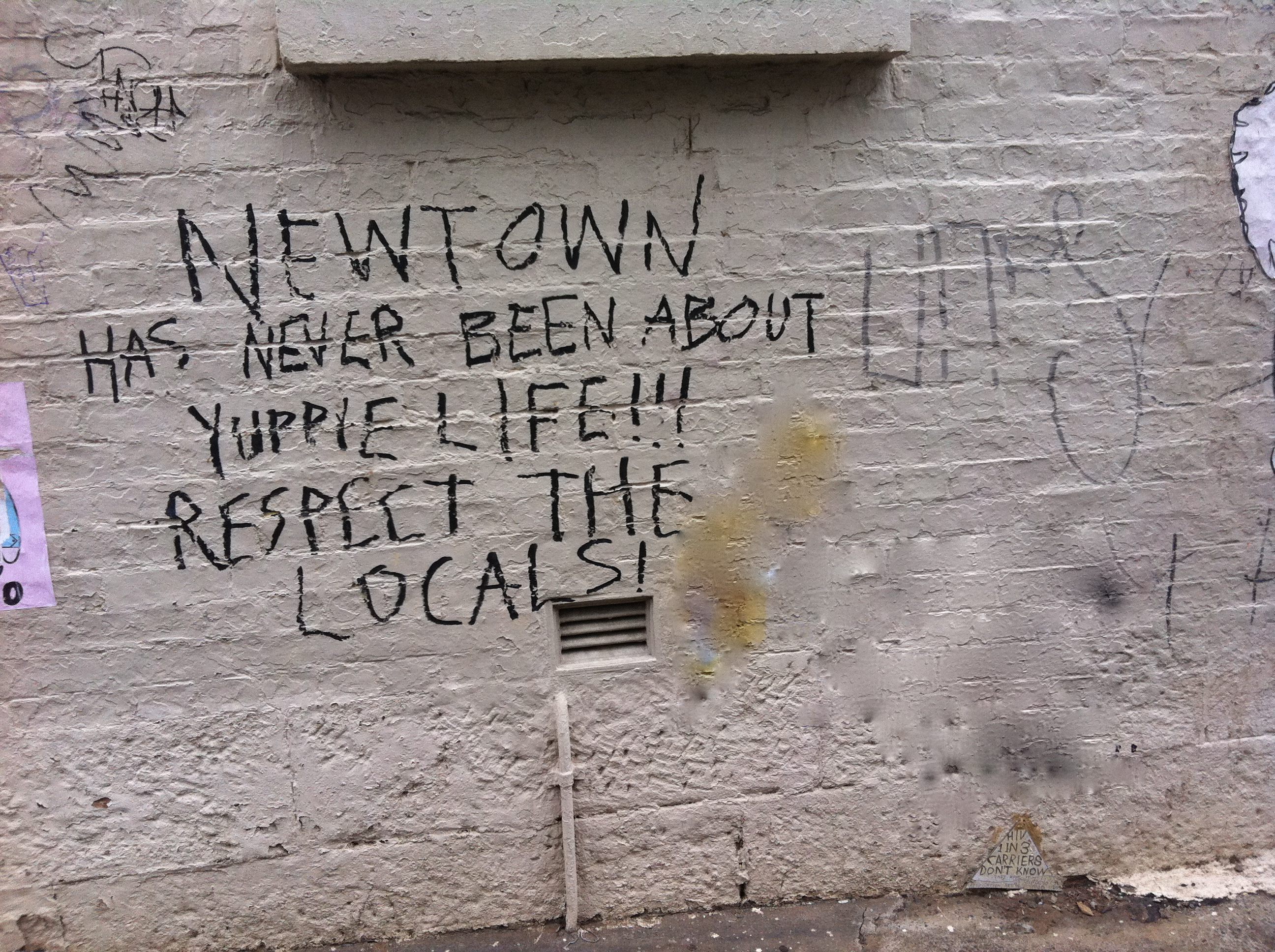
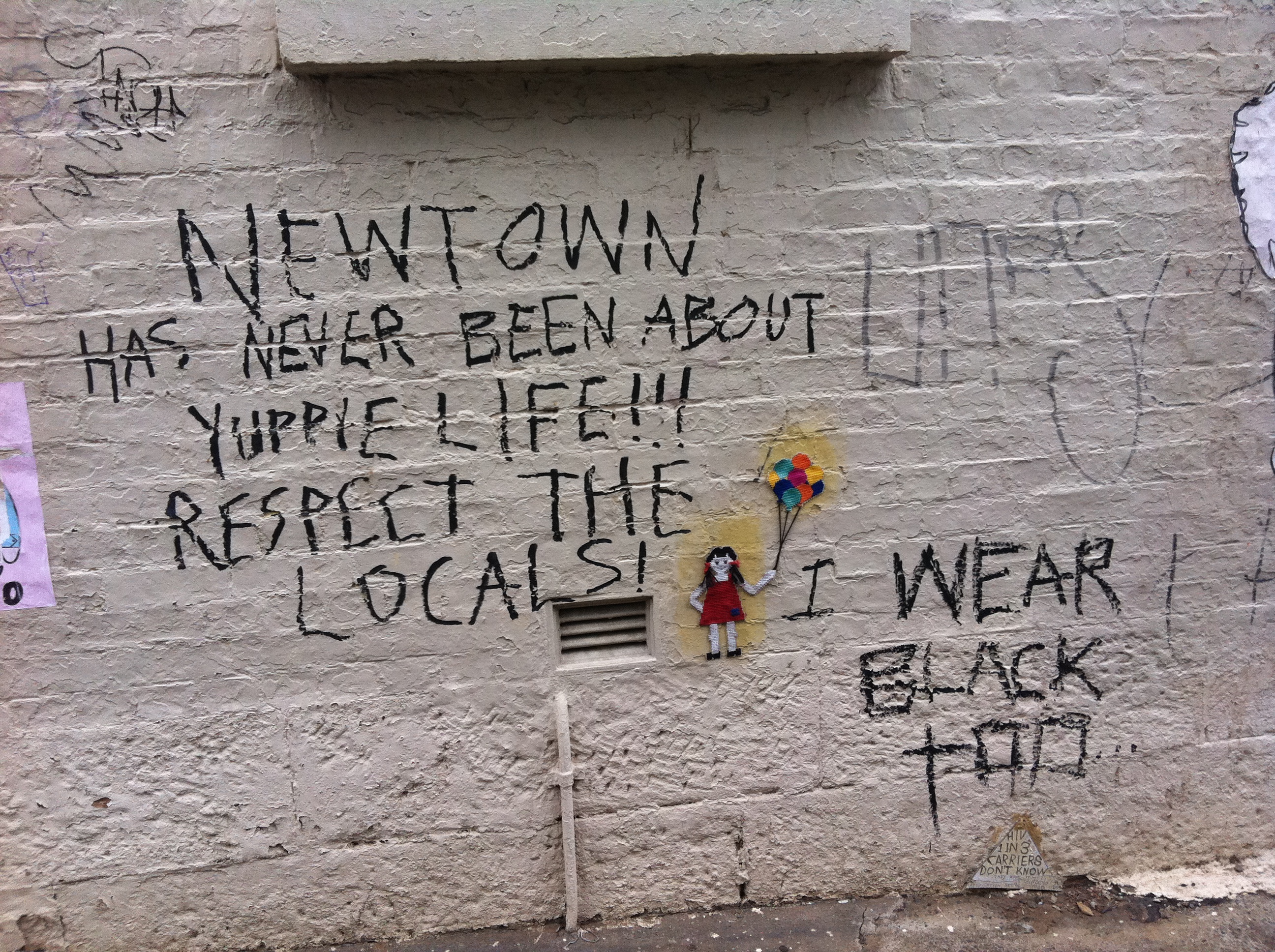
Here’s a nice non-facebook wall conversation from a neighbouring suburb. If I had Photoshop I would restore YUPPIE in the first image to YOUR, which is what was there the first time I saw this wall.
Someone who felt this message was intended for them struck back:
Then yesterday a third and perhaps even a fourth, dauber chimed in:
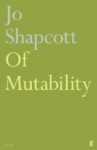
I never know how to write about a poetry collection, where every page is a new beginning. Some poems grab you, some don’t. Some yield their meaning immediately, some take a while, others need a bit of research before they make any sense at all. Occasionally you have to put the book down and go for a walk to get used to a world where what you’ve just read can exist. Sometimes you’re compelled to read something aloud to a friend who happens to be at hand, whether they want to be read to or not. All these things were part of my experience of reading Of Mutability, which was Book of the Year in this year’s Costa Book Awards. (Thank you, judging panel, for pointing me to it.)
I often feel that I need a bit of help with poetry, and dust jackets, being unavoidably more interested in potential buyers than actual readers, aren’t always much help. The dustjacket flap here, for instance, talks about poems ‘which have a way of turning physics into the physical, the subatomic field of matter into one vast erogenous zone’. That’s all very sexy, but it doesn’t help with, say, these lines from ‘Era’, early in the book:
I left home shortly after eight-thirty
on foot towards the City. I said goodbye
to the outside of my body: I was going in.
What would have helped was a little note somewhere telling us that many of these poems were written when the author was dealing with breast cancer. OK, not such a good marketing ploy, and any bookshop browsers who weren’t put off might buy the book expecting something like a Health Crisis Novel in Verse, only to be bitterly disappointed to find that many of the poems are about other kinds of mutability (dementia, ageing, the seasons …), and some about completely unrelated subjects such as urban architecture or peeing.
It turns out that, though I found out about the breast cancer elsewhere, Jo Shapcott points the acute reader to that information, and offers other useful tips, in her acknowledgements. An electronic version might present the last part of the acknowledgements something like this:
Adding those links and titles took me far too long, but if you were to read a version of the book with them in place, life would be much simpler. You could not only be looking at images of the two works by Helen Chadwick within moments, you could find out with two clicks that doctors Guglani and Elyan specialise in cancer, and you’d have a fair idea of what they and their team did for the poet: ‘I was going in’ starts sounding a lot more like surgery than catatonia. Cancer isn’t named anywhere in the book, but things like:
Too many of the best cells in my body
are itching, feeling jagged, turning raw
or
forgive, and forget what's
happening in my cells.
It's you I'm thinking of
work a lot better for me if I have a ballpark idea of what’s going on with the cells.
Of course, I wouldn’t have gone searching like that if the poetry hadn’t already grabbed me, and some of the poems don’t need any supporting apparatus at all. ‘Procedure’, which you can hear Jo Shapcott read in this interview with Sarah Crown of the Guardian, is one such. Perhaps my favourite of the selection, ‘Uncertainty is Not a Good Dog’
Uncertainty is not a good dog.
She eats bracken and sheep shit,
drops her litters in foxholes
and rolls in all the variables

wriggling on her back until
she reeks of them,
until their scents are her scents.
is another. (That’s not the whole poem, in case you’re wondering.)
Two last remarks: baldness will never look the same to me again, and the phrase ‘piss holes in the snow’ is changed forever.
After 14 years, Heat is to appear no more in book form. In this final issue Ivor Indyk, the editor and publisher, departs from his usual practice and speaks to us, explaining the reasons for his decision and sketching some possibilities for an electronic afterlife. (He spoke again to Ramona Koval on the Book Show.) The sad economic reality is that as a 240 page book, Heat is a monster to produce several times a year and then to distribute and warehouse. The community of people who are glad of its existence is much larger than the journal’s market – the people who buy it, and so contribute to its viability. As I’ve subscribed for ten years and written blog entries (I don’t really think of them as reviews), I have a twinge of smug virtue mixed with my sorrow: like, ‘It’s not my fault!’ I don’t know that I’ve ever felt part of a Heat community – too middlebrow, too whitebread, too shy – but it hasn’t been a purely economic relationship. I’ll miss this regular dose of austere high culture, and emergent/experimental/cosmopolitan writing.
Some of the culture in this final issue is incontestably high. Adrian Martin’s article, ‘Devastation’, after a wonderful anecdote about a working class man’s response to Terence Davies’ Distant Voices, Still Lives, goes on to discuss the films of Maurice Pialat. I’m a keen and frequent filmgoer, but I had to check with Google to be sure the article wasn’t a spoof and Pialat a comic invention – an archetypally grim French auteur whom Martin praises for daring to have sitting and standing characters in the same shot, and compares to a number of other auteurs I hadn’t heard of. It’s not a spoof: it’s the kind of article that sheds enough light on its subject to reveal the dark vastness of its reader’s ignorance. By way of contrast, Andrew Riemer’s brilliantly erudite ‘Four Glimpses of the Zeitgeist’ takes one gently by the hand and illuminates a web of connections joining Freud, Mahler, Riemer’s ancestors, conductor Bruno Walter, His Master’s Voice records, Hitler, playwright Thomas Bernhard and others, all converging in a Viennese theatre in 2010. Jeffrey Poacher’s reflection on the poetry of Peter Porter , who died last year, is likewise kind to general readers without, I hope, boring those who know Porter’s poetry well.
Cosmopolitanism is alive and well, particularly n Andreas Campomar’s ‘Uruguay Made Me’, a discussion of Eduardo Galeano in the context of his native Uruguay that makes me want – need – to read Galeano.
There’s plenty of emerging/experimental work too, mainly in the poetry. I was happy to see two typographically adventurous poems by Patrick Jones, who commented critically on this blog a while back.
But I don’t want to get hung up on classification. There’s a terrific poem by Adam Aitken dedicated to Susan Schultz – both Adam and Susan have graced my comments section recently. Ali Alizadeh and Jennifer Maiden are in fine form. Alan Wearne does some Gilbertian editorialising on the current move to form an Australian peak industry body for poetry. Amanda Simons interviews Antigone Kefala on her writing practice: Kefala says that, for her, writing and speaking are two completely different forms, and it’s delightful to encounter the conversational Antigone here alongside two characteristically non-conversational poems (there’s that austere high culture again).
I was struck by two examples of things a book you hold in your hand can do that a boundless (the word is from Ivor Indyk’s editorial) electronic creation can’t. In Nicolas José’s ‘What Love Tells Me’ a recently widowed man and his young son attend a performance of Mahler’s Third Symphony where the ‘blasting and pummelling and smashing’ music opens them up to emotional resolution and communication. The story is moving in its own right, but it gains an extra fizz from the fact that 150 pages earlier Andrew Riemer has been telling us something of what Mahler’s music (though not this precise symphony) meant at the time it was written. In my mind at least, that mental connection is made possible by the weight of the book in my hand
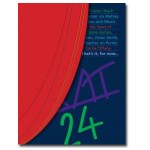
The other moment is a theatrical coup in Gillian Mears’ ‘Fairy Death’. This memoir begins with a title page: a right-hand page that’s blank except for the title and a brief note on the author. When you turn over, expecting the story to begin on the verso, you find instead a striking image of what seems to be a dress-shop mannequin with a crack or join around its middle, arranged on a bed and photographed from above. The figure’s face makes you realise that it’s actually a live, extraordinarily thin woman, that what looked like a join is a string tied around her waist and attached to what you now recognise as a red balloon in the photo’s foreground. The photo, taken by Vincent Lord Long, is of the author, and her mannequin-like thinness is the result of advanced multiple sclerosis. The article is in part an account of how it came to be taken. Though the memoir is astonishingly powerful, addressing (with what in another context would be Way Too Much Information) the effects of MS on the author’s sexuality, the act of turning the first page onto that image creates extraordinary poignancy – which I don’t believe could happen in an electronic form.
One perhaps minor advantage of ceasing to exist as a physical object is that proofreading and even copy editing can continue after publication. Heat 24 is far from egregious in that department – apart from a miniscule (which is a special case as the Microsoft spellchecker ignorantly allows it), I was plunged into confusion and irritation by only one editing error, which I won’t bore you with. It looks as if the presumably underpaid copy editor had enough time and/or other resource to do an excellent job on this issue, so he can go out with his head held high.
Just to be half clever, here’s the last stanza of John Shaw Neilson’s ‘The Poor Poor Country’, slightly altered:
The New Year came with Heat and thirst and the little lakes were low,
The blue cranes were my nearest friends and I mourned to see them go;
I watched their wings so long until I only saw the sky,
Down in that poor country no pauper was I.
Update 1 March 2011:
Over at Adam in (), Adam Aitken was kind enough to link to this page, and he asked me a question. I tried three times to respond in his comments section but for some reason my comments wouldn’t stick, so I’ll have go here.
Adam:
Jonathan, I don’t know why you see yourself as “whitebread”. Are HEAT writers “brownbread”? I won’t miss the so-called austerity of HEAT, as I feel on the contrary that HEAT would sometimes verge on the too rich, too dense side of things (by virtue of each issue being such a fat book).
Well, Adam, I’m not sure where I picked up the term ‘whitebread’, but my (now former) suburb, Annandale, got described that way by some of my more hip friends. They meant that the people of the suburb were the kind who ate only white, preferably sliced and packaged bread, remaining ignorant of or uninterested in the existence of pumpernickel, sourdough, ciabatta and challah, let alone pita, roti and naan. So my implication was Heat writers (and anyone else who belongs to its community) can come from anywhere in that vast world of different breads (quite a few of which are actually white, come to think of it). I have never read an issue of Heat without having my horizons extended, and I was amusing myself by saying that in a self-deprecatory way.
I agree with you on the richness and density of Heat. It’s been admirably austere in the sense that it would never have given us a review of the latest Oprah recommendation or blockbuster movie, and in a different way I’ve thought of Ivor Indyk’s editorial silence as austere. In this final issue he speaks to us, but presents it as asking our indulgence. I for one would have happily indulged him in this way many times over.
VIDA, an organisation concerned with women authors, has published statistics on the gender of authors writing for a number of literary journals, and reviewed by them. The figures are alarming, though I suppose they shouldn’t have been surprising. Michael Schaub, on the unfortunately named Blog of a Bookslut, examined his own statistics and was shocked, having assumed that the books he reviewed were roughly 50 per cent by men and 50 percent by women.
Rising to the challenge I had a look at the books I wrote about in 2010. I secretly hoped, of course, to find something close to 50–50. It turned out I wrote about 19 books written by women, 52 by men, and one that was written by a man and a woman. (I’m including the books I gave up on after 50 pages or so, of which at least two were by men and one by a woman.) That means I managed a little more than 37 per cent. Oops! It’s small consolation that the proportion of women authors on my blog is substantially bigger than VIDA’s equivalent for The New Yorker, The London Review of Books and others.
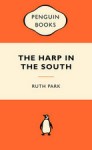
Our Book Group’s last title was Delia Falconer’s Sydney, which quotes liberally from Ruth Park’s writing about this city from the middle of last century. One guy was keen to have Park’s Companion Guide to Sydney as our next title, but the general feeling was that we didn’t want another book about Sydney (Jan Morris’s Sydney was rejected for the same reason). The Harp in the South – a novel set here – was proposed as a compromise, and rejected on the night, but when the next day the papers were full of news that Ruth Park had died we ditched our first choice.
Before the meeting: I loved this book. I believe it was written with the passionate aim of calling attention to the lives of the poor in Sydney’s inner suburbs. That documentary impulse means that 60+ years later it’s full of fascinating historical detail: the shape of Australian coins in the 1940s, the way garbage was collected in Surry Hills (dumped from household rubbish bins onto a big sheet of hessian laid out in the street), how the poor celebrated New Year’s Eve (with a bonfire built from the neighbourhood’s rubbish), ways of thinking about sexual morality, sexual politics, Aboriginality, cultural diversity (yes, in the 1940s that we’re always being told were totally monocultural). I don’t mean to imply that my interest was purely anthropological-historical: the woman who was to give the world the Muddleheaded Wombat knew how to create solid human characters and spin a gripping yarn. In the late 1940s the book caused upset by insisting that its slum-dwelling characters be taken seriously, and that unpalatable facts of life such as abortion be acknowledged. The subject matter is no longer shocking, but some of the characters’ resigned acceptance of, say, a touch of domestic violence or callous racism can still wring a reader’s withers.
We follow the lives of the Darcy family: overweight Mumma who holds everything together, Hughie who has given up on life and seasons his stoicism with alcohol, teenage Roie and her younger sister Dolour. Roie’s two romantic relationships – one disastrous, the other redemptive – constitute the backbone of the plot. Her febrile panic as she finds true love is wonderfully realised. The young Ruth Park was well up to the challenge of writing about sex without what has come to be known as explicit language. There’s a brilliant example in the account of Roie’s wedding night. Roie is frightened. She eventually gets into bed and Charlie, her new husband, comes out of the shower, drying his tousled hair:
He looked down at her. ‘Are you scared of seeing me with my clothes off?’ ‘A little bit.’ He dropped the rest of his garments on the floor. He was slender and shapely and tawny-skinned. His neck rose out of his shoulders like a short pillar of bronze; his dark head was beautifully set on it. He looked at her without any selfconsciousness, without any shyness or embarrassment in his golden eyes. ‘I’m just like other men.’
That seems bland enough, but then, if you’re me, you realise that Roie has seen Charlie’s head and neck a thousand times, she’s just been swimming with him so she knows what his body looks like. You realise we’re meant to see through the chaste language here and understand that Roie is actually looking at a different short pillar with a dark head on it, and finding what she sees to be beautiful.
At that moment, I fell in love with Ruth Park.
After the meeting: Sadly, a sudden intense flu-ish infection meant I didn’t go to the meeting last night. The official report, just to hand, said: ‘Mostly approved of Harp in the South, as much for its historical flavour as for its literary qualities. Then a deep discussion about whether men are afraid of other men.’ So I didn’t get to see whether my reading of that wedding-night passage would be dismissed as peremptorily as my finding a coded reference to Aboriginal massacre in The Tree of Man.

 On a Sydney Writers’ Festival panel some years ago Inga Clendinnen indulged in a flight of metaphor, saying that the writer of a personal essay takes the reader by the hand and says, ‘Come walk with me,’ while a novelist invites a reader to play Catch-me-if-you-can. The novelist who chaired the panel commented afterwards that though he adores Inga (as who doesn’t?), he was a little offended. At the risk of offending poets everywhere then, I’d like to suggest that the author of a book of poems is saying, ‘Come in, make yourself at home, stay a while.’



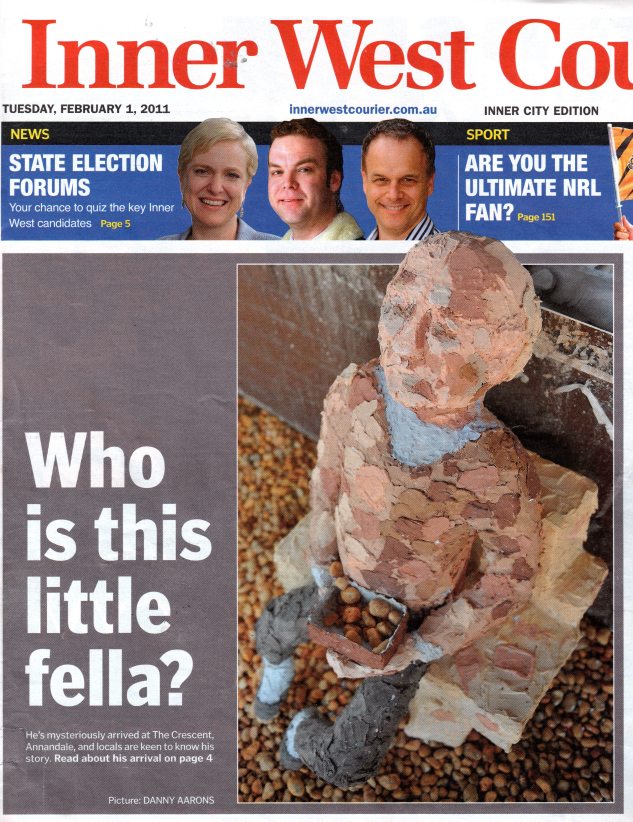 Today’s Inner West Courier has